Search

Follow me on ResearchGate

Follow me on ResearchGate

Pages
Social networking
Saturday
Nov102007

New name for Creationsists... 'New term for creationists: 'cdesign proponentsists'

I call it majoring in minors... You know, like when one gets close to the end of an academic year - the pressure is on, tempers are running high, and students don't have much grace for one another. And so, instead of doing what they should be doing (studying for their final exams), they find things to fight about! They end up missing the mark because they're majoring in minors.

I think the creation / evolution debate is one of those... We have so many bright, creative, committed Christians (from both camps) who are alienated from each other, whose energy and time is dissipated, and their attention is diverted from what really matters (that God loves the world, that God desires for us to be agents of change and renewal in the world etc...)

Anyway, here's an interesting post on a new controversy in the 'creationist' camp:

MAKE senior editor Phillip Torrone reviewed NOVA's Judgment Day: Intelligent Design on Trial.

200711091301When the advocates of Intelligent Design during the trial said that the book "Of Pandas and People" had nothing to do with creationism, they lied; it turned out the original drafts were all about Creationism. After the drafts were subpoenaed (thousand of pages) it was discovered that a simple search and replace was used to change the text from creationism wording to something, well, less creationism sounding. It was changed because the Supreme Court in 1987 ruled it was unconstitutional to teach creationism in public schools. When I say "search and replace" I really mean they found examples of where the words didn’t exactly get changed enough. You can see it here...

Wherever the word "creationists" appeared it was replaced with "cdesign" "proponentsists" - that’s merely creationists without the "reation" and with "design" and "proponents" replaced in.

Link

Another example of sincere people missing the point...

Technorati tags: , ,

Saturday
Nov102007

American BLOG amazed that South African ATM offers 8 language choices - Koreans mustn't look at women in toilets [pictures]

BoingBoing has this picture of an ABSA Bank ATM on their front page! They are amazed that you can choose from 8 different languages on an ATM here in South Africa.

It's called DIVERSITY... Pronounce it slowly... DIE VER CI TEE.... Not everyone who is of a different race, different gender, different language, or different cultural background is to be forced into a North American English mold, have their country invaded, their natural resources plundered and their ATM's changed to English! Oooopppps, that was just a rant. I deserve to be flamed for that! Sorry.

Can you imagine how the picture taker would have felt if he had discovered that we actually have 11 official languages in South Africa and that the majority of South African speak as many as 4 languages (English, isiZulu (or Xhosa), Sotho (or a variant thereof), and Afrikaans)?

Now that I have upset the Americans, and I do appologise! Truthfully, I have never yet met an American who is what the stereotypes suggest. My experience is that whilst the 'nation state' is quite self obsessed and abusive, all the Americans I have met are just great, open minded, people...

So, now let me poke some fun at South Africans (let's see if I can upset everyone this morning... Sorry!)

When I was in South Korea last year I was amazed to see this sign warning women to watch out for men looking over the tops of toilet stalls... I thought 'how bizarre', but then a Korean friend ask me a simple question, "Do you think it doesn't happen in South Africa", to which I replied "well, I'm sure it does". So he said, "well, why not do something to stop it?"

Sensible! It's amazing what we find strange about one another! Any other crazy signs out there? Just post a link to the comments or email me.

Technorati tags: , , ,

Saturday
Nov102007

If you're thinking of joining an 'organised crime syndicate' (like the Mafia, the Nigerians, or the cowboys!?) here are 10 commandments to help you!

Yup, our minister of Justice informed us (South Africans) on Thursday this week that 'organised' crime was growing at such a rapid rate in Southern Africa that they were unable to cope with it.

When I heard this I thought two thoughts (which is an incredible feat for me! I had to lie down afterwards!)

First, I thought that it is never a good idea to announce to your citizens that you don't have a handle on crime!!

Second, I thought that having made that very astute announcement to the public, many enterprising persons may consider joining a crime syndicate of some sorts since there seems to be little chance of being caught!

So, here are the 10 commandments for joining the Mafia [insert name of organised crime syndicate here]:

The BBC reports that when Italian police searched a Mafia boss' hideout, they found a list of ten rules for proper mafioso etiquette.

1. No-one can present himself directly to another of our friends. There must be a third person to do it.

2. Never look at the wives of friends.

3. Never be seen with cops.

4. Don’t go to pubs and clubs.

5. Always being available for Cosa Nostra is a duty - even if your wife’s about to give birth.

6. Appointments must absolutely be respected. [someone should teach our mafia friends that split infinitives are never acceptable in English sentences!!! Perhaps they should have a language editor read their work before making it public, or putting it into print... Just a thought - Dion]

7. Wives must be treated with respect.

8. When asked for any information, the answer must be the truth.

9. Money cannot be appropriated if it belongs to others or to other families. [This makes for a pretty poor crime strategy! Heck you couldn't even be a small time dictator, or the next President of the ANC with a strategy like this! These guys should spend a bit of time with our politicians to see how to 'miss-appropriate' the funds of others. Just a thought for criminals... Dion]

10. People who can’t be part of Cosa Nostra: anyone who has a close relative in the police, anyone with a two-timing relative in the family, anyone who behaves badly and doesn’t hold to moral values.

Very interesting isn't it! Heck, these guys obviously operated in a time when honour was far more important than success... Now compare the above to Gene Autry's Cowboy Code (from 1930 - look how clean cut he is! Rule 8 makes perfect sense), which I think is just about the best set of rules for living a good life that I ever seen:
1. The Cowboy must never shoot first, hit a smaller man or take an unfair advantage.

2. A Cowboy must never go back on his word, or a trust confided in him.

3. A Cowboy must always tell the truth.

4. A Cowboy must be gentle with children, the elderly and small animals.

5. A Cowboy must not adovcate or possess racially or religiously interolerant views and ideas.

6. A Cowboy must help people in distress.

7. A Cowboy must be a good worker.

8. A Cowboy must keep himself clean in thought, speech, action and personal habits.

9. A Cowboy must respect women, parents and his nations's views.

10. A Cowboy is a patriot.

Link (Via The Day The Tried to Kill Me)

I thought this was quite good. At some stage we tried to design a 'code of conduct' for Methodist ministers. We do have the 'Rules of the Helper', but we wanted to make something more contemporary.... One of the rules was not to argue, but we couldn't agree on that, so we gave up ;-)

Technorati tags: , , , ,

Friday
Nov092007

Just to remind you what a Vespa SHOULD look like... Here's a picture of my old girl...

Yeah, I know, she's painted Orange and I'm not a Cheetahs fan (the South African Cheetahs rugby team have orange as their colour), but heck you have to admit that my old Vespa looks sweet!!!!

She is a 1967 Vespa Sprint VLB. You'll see me buzzing around Pretoria on her in both summer and winter.

I love the contrast between the paint on the bike and the bricks at my office. Don't you?

I haven't ridden her in a few days - I have an hour or so tomorrow morning, I think it's time for another ride!

Now, now, remember that ENVY is a sin! Any other Vespa lovers out there!?

Technorati tags: , ,

Friday
Nov092007

A list of people with the highest IQ's on record... See if your name is listed here.

Some years ago I wrote a paper on IQ (intelectual quotient), EQ (emotional quotient) and SQ (spiritual quotient). If you're interested in these concepts read the blurb below and download the paper, otherwise just scroll beyond it to see who the REALLY smart people are!

Title: Spiritual Quotient: A neuro-theological key to wellness and wholeness.

Abstract: Research in both science and theology has begun to move away from reductionist and mechanistic views of the human person towards approaches that emphasise the interaction and inter-relationship of the various systems of human being. This paper aims to discuss some of the implications that intelligence, and in particular spiritual intelligence (also called SQ), may have upon the wellness of a person as a whole living, spiritual, being. The paper will start with a discussion on the three primary systems that constitute a whole person. Next there will be some insight into the functioning of the human brain. This will be followed by a presentation of the three dominant forms of intelligence (IQ, EQ and SQ). These are commonly identified through a study of the functioning of the human brain. After that some time will be spent looking at the theological implications (neuro-theology) of spiritual intelligence, discussing some possible effects that this form of intelligence could have on wholeness and wellness in human being. Finally, the paper will end with some suggestions on the development of a spiritual life that will be beneficial to wellness.

Here is the paper itself: (please note that it is not in final form, and so is not yet suitable for quoting. Thank you).

SQ paper TSSA 2005 draft.doc

OK, enough of that, so are you ready to find out who the smart folks are?

Here goes (this post comes from here):

Background Info

In order to establish a baseline knowledge, IQ (intelligence quotient) is a score derived from attempting to measure the actual mental horsepower of any given individual. Personally I place little value in IQ tests, but I do acknowledge that they are an indicator of some common potential success factors, so we’ll leave it at that.

The “average” IQ is by definition 100, so if you score below that you are dumber than average, and above it means smarter than average.

IQ Bellcurve
The distribution of IQ scores is as follows:

People Still Alive

From the Past

In 1926, psychologist Dr. Catherine Morris Cox - who had been assisted by Dr. Lewis M. Terman, Dr. Florence L. Goodenaugh, and Dr. Kate Gordon - published a study "of the most eminent men and women" who had lived between 1450 and 1850 to estimate what their IQs might have been. Data from that study as well as other sources around the net were compiled to form the following list. Please drop me a comment if you have additions or corrections (make sure and cite sources).


Also, see Wikipedia's list of Universal Genius (Polymaths).

Technorati tags: , ,

Friday
Nov092007

Weird blog post of the day - What happens when SPAM is turned into art? [Picture]

Like most of you I get LOTS of spam in my inbox every day! Invitations to get a cheap mortgage (whatever that is... In South Africa we only have home loans), the best price of cheap degrees (what the heck for, I've already bought my fair share) and adverts to extend certain parts or... well you know, swallow the blue pill...

Well, have you ever considered what it would look like if SPAM headlines were turned into works of art? Now that's the kind of stuff any self respecting internet Junkie needs to have on their office wall!

Go here for more - Enjoy!

This is the blurb from BoingBoing:


Linzie Hunter paints illustrations that incorporate the subject lines of the spam she finds in her in-box. She captures the daffy mania of spam-subjects perfectly, too! Link (via Kottke) See also: Spam subjects printed on custom tees

Technorati tags: , , ,

Friday
Nov092007

Widows, witchcraft, and the abuse of African culture to deny Southern African women their rights...

Culture is a necessary thing - it structures our lives in relationship, it adds meaning and depth to communal practices, it enlivens our history, and shapes our future.

You would know that I ardently encourage the adoption of the ideology of ubuntu as a principle for relationship based justice, harmony, and equity. I do so primarily because there is so much of this ideology that can positively shape society (particularly societies that have become competitive, self obsessed, and disregarding of the rights and responsibilities that we have for one another's wellbeing). In fact, I find many more Gospel values in the principles of ubuntu than I do in Western Capitalist individualism...

However, there is a HUGE disconnect between the ideology of ubuntu and its ethical application in contemporary Southern Africa. Whilst the ideology is touted by many, there are very few who hold it dear enough to actually practice it!

I wrote a paper on this subject that you download and read here.

Sadly, my experience has been that even in traditional African communities, as soon as the individual can afford a BMW, buy a house in the subburbs, and outwit, outlast and outplay other persons, the ideology and philosophy of interdependent identity and harmony in relationship is chucked out of the windows in the pursuit of individual gain!

Sadly, culture is abused by many as a tool to justify abusive practises, and at the same time avoid responsibility. This disturbing article comes from the Mail & Guardian newspaper.


While the United Nations Millennium Development Goals aim to empower women and eradicate poverty, Southern African inheritance practices are having the opposite effect -- leaving widows impoverished, maligned and separated from their own children, says a recent study out of Mozambique.

The study by Save the Children highlights how tradition -- which dictates that the man's family can devolve the deceased's assets among themselves -- leads to widows being made scapegoats for their husbands’ deaths and losing custody of their children.

Maria Delia and Isauru Mandlate, part of the team that conducted the study for the Save the Children Foundation in Mozambique, say that in addition to dealing with bereavement, a widow faces the immediate loss of her home and all her possessions.

Women are commonly accused of bewitching their husbands and causing their deaths, and this is used as a pretext for refusing them their inheritance.

“The family is not interested in negotiating, they just want the goods, "says Delia. “This is revenge for her having 'killed' her husband. They are really rough and don’t leave her with a single penny."

But even more painful than the loss of material possessions, say the researchers, is the way the husband’s family will poison the children’s minds, leading them to believe their mother is responsible for their father's death.

"The children are not allowed to visit their mother -- the children are told to run away from their mother if she comes to visit," says Delia.

Widows who refuse to participate in the ritual of "purification" -- which requires them to have unprotected sexual intercourse with a male member of their husband’s family to dispel bad spirits -- are banished from the family and even the district.
The result is that dispossessed widows turn to sex work or cheap manual labour to survive and are more vulnerable to risky sexual activity and HIV infection.

Delia tells the story of a young widow whose husband died of Aids. "Her husband had gone to South Africa to work on the mines and while he was away she lived with her in-laws. When he became ill he came home and she cared for him. When he died, they [the in-laws] kicked her out."

The woman ended up living in a mud hut, without even a bed to sleep on and just the clothes on her back. She survives on the few stalks of maize and vegetables she can grow.

The study says patrilineal African societies view male heirs as continuing the family line, while women are seen as assuming only the role of temporary guardians of assets. As a result the deceased's family members feel they are entitled to all his material possessions -- even if the widow has worked to contribute to the shared assets.

The report notes that despite Mozambique being a signatory to instruments such as the UN Convention on the Rights of the Child, the UN Convention on the Elimination of all forms of Discrimination Against Women and the African Charter on the Rights and Welfare of the Child, the government has yet to produce comprehensive legislation on inheritance.

In South Africa this tradition has been challenged by progressive human rights legislation, where a precedent was set by the Constitutional Court in 2004.

Nontupheko Bhe, a widowed Khayelitsha woman, approached the court to have the Black Administration Act -- which provided that if Africans died intestate their estate would be devolved according to customary law -- declared unconstitutional.

The court ruled that the Act was an "anachronistic piece of legislation which ossified 'official' customary law and caused egregious violations of the right of black African persons” and found that "whatever the role of male primogeniture may have played in traditional society, it can no longer be justified".

Despite this landmark ruling, the law is often at odds with deep-seated cultural norms and many women remain unaware of their rights.
"In many instances the widow is made aware of her rights too late and the assets have been claimed by the in-laws or the livestock is already sold," says Busi Motshana, a para­legal at Tshwaranang Legal Advocacy Centre in Acornhoek, Limpopo.

In addition to ignorance of their rights, there is also a culture of silence among women and children -- who are generally passive participants in traditional society. In rural areas access to facilities and institutions of justice is an added obstacle. The drawing up of a formal will is rare, in part due to issues of access, but also due to the fear that doing so is tantamount to inviting an early death.

"This is becoming an issue as more people die of HIV/Aids," says Delia.

"More needs to be done in the communities to educate and inform these women on their rights and also encourage community reform."

Technorati tags: , , , , ,

Thursday
Nov082007

Join Dion's Random Ramblings' MyBlogLog community!

I make use of a few community tools to keep an eye on statistics on this blog. The one that seems to drive the most traffic here (thanks Steve for pointing me in this direction!) is the Yahoo! community called MyBlogLog. So, if you're a blogger and you want to get some more traffic to your site sign up for a yahoo ID (if you don't already have one) and join my community... We all send traffic to each other.

The majority of my traffic comes from Steve and Stephen (both rocks of the Church! Although from quite opposite sides of the theological spectrum, Steve is an Orthodox Christian, I have known him since before the REAL internet when he was running a BBS! Steve and I also served on the Standards Generating Body for Theology and Ministry that designed the Theology qualifications used by South African Universities, Colleges and Seminaries... Stephen is reformed / emergent, I have never met him, although I am constantly challenged by his great blog posts... He also happens to live in Cape Town, and if I remember he is a Stormers supporter - which means that he dwells richly in God's favour!)

So, sign into MyBlogLog community and let's see how much traffic we can send each other!

Technorati tags: , ,

Thursday
Nov082007

What happens when an AGNOSTIC tries to live according to a literalist reading of the Bible for a year?

Well, you'll find the answer below. Of greatest interest is the fact that a literal reading of the TEXT, without the one who is the only true WORD OF GOD (Jesus, according John 1) makes it impossible.

I found this post amazing! I need to read this book.

Here's Richards' reflection:

A. J. Jacobs, author of my second favorite book of 2004, The Know-It-All: One Man's Humble Quest to Become the Smartest Person in the World, in which he reads the entire thirty-two volumes of the Encyclopaedia Britannica in one year, has attempted another magisterial feat. However, he quickly finds his new endeavor is easier said than done.

His quest: to live the ultimate biblical life.

Or more precisely, to follow the Bible as literally as possible. To obey the Ten Commandments. To be fruitful and multiply. To love my neighbor. To tithe my income. But also to abide by the oft-neglected rules: to avoid wearing clothes made of mixed fibers. To stone adulterers. And, naturally, to leave the edges of my beard unshaven (Leviticus 19:27). I am trying to obey the entire Bible, without picking and choosing. (3-4)

He begins by reading straight through the Bible over a four week period. He documents “every rule, every guideline, every suggestion, every nugget of advice” (8). The fruit of his labor is a seventy-two page list with over seven hundred rules. This is shy of the 613 rules originally compiled from the Torah by the medieval rabbi Maimonides, but Jacobs includes the whole Bible.

He initially encounters two problems: (1) how to follow some of the “crazier” commands of the Bible, and (2) how to follow commands that call for love and devotion to God.

In regard to following the “crazier” commands, he writes of something that anyone familiar with the Bible knows. He calls it “one of the biggest mysteries of the Bible.

How can these ethically advanced rules and these bizarre decrees be found in the same book? And not just the same book. Sometimes the same page. The prohibition against mixing wool and linen comes right after the command to love your neighbor. It’s not like the Bible has a section called “And Now for Some Crazy Laws.” (43)

With the help of an earnest shatnez (“mixed fibers”) tester named Mr. Berkowitz, Jacobs soon learns how to keep from mixing two types of material. He also invents a creative way to obey the command to not touch a woman during the time of her period (see Leviticus 15:19). Since he can’t touch his wife or anything she sits on for a week, he buys a portable folding stool that he carries everywhere.

Over time, he comes to discover that even the strangest commandments may have value. After all, should anyone really expect to fully understand every reason behind God’s commands? And perhaps if one searches hard enough, one can find positive reasons for even the oddest commands. For example, in regard to God’s declaration that locusts are “clean” food Jacobs discovers,

The only way for the poor to survive was by eating the locusts themselves. So if the Bible didn’t approve of locust eating, the poorest Israelites would have died of starvation. This I like. More and more, I feel it’s important to look at the Bible with an open heart. If you roll up your sleeves, even the oddest passages—and the one about edible bugs qualifies—can be seen as a sign of God’s mercy and compassion. (176)

The second problem he encounters is his realization that “the Bible commands you not only to believe in God but to love Him. It commands this over and over again. So how do I follow that?” (20) He attempts to act out the faith even though he does not really believe it. This causes him to worry about breaking the Third Commandment: “If I don’t believe the holy words I’m saying, isn’t that taking the Lord’s name in vain?” (21)

During his year-long quest, Jacobs makes some surprising and enlightening discoveries. I recount a few.

He comes to value many of the insights of the Bible. For example, in regard to the Bible’s prohibition on idolatry and suspicion of images in general, he writes,

I think there’s something to the idea that the divine dwells more easily in text than in images. Text allows for more abstract thought, more of a separation between you and the physical world, more room for you and God to meet in the middle. I find it hard enough to conceive of an infinite being. Imagine if those original scrolls came in the form of a graphic novel with pictures of the Lord? I’d never come close to communing with the divine.
The Bible is right: A deluge of images does encourage idolatry. Look at the cults of personality in America today. Look at Hollywood. Look at Washington. I’d like to see the next presidential race be run according to Second Commandment principles. No commercials. A radio-only debate. We need an ugly president. I know we’re missing out on some potential Abe Lincolns because they’d look gawky and gangly on TV. (106)

It is particular touching when he experiences authentic praise welling up from within and gives voice to it. He recounts this realization “that felt like a punch to his stomach:

Here I am being prideful about creating an article in a midsize American magazine. But God—if He exists—He created the world. He created flamingos and supernovas and geysers and beetles and the stones for these steps I’m sitting on.
“Praise the Lord,” I say out loud.
I’d always found the praising-God parts of the Bible and my prayer books awkward. The sentences about the all-powerful, almighty, all-knowing, the host of hosts, He who has greatness beyond our comprehension. I’m not used to talking like that. It’s so over the top. I’m used to understatement and hedging and irony. And why would God need to be praised in the first place? God shouldn’t be insecure. He’s the ultimate being.
Now I can sort of see why. It’s not for him. It’s for us. It takes you out of yourself and your prideful little brain. (220)

This is a surprising discovery from one who begins the book by declaring, “I’ve rarely said the word Lord, unless it’s followed by of the Rings. I don’t often say God without preceding it with Oh my” (21).

He also discovers something that many faithful Christians have yet to acknowledge. In the midst of Jacobs’ feverish attempt to follow the Bible literally, a friend warns that he is treading on thin ice. Jacobs writes, “He told me: Stop looking at the Bible as a self-help book. That is the way I view it a lot of the time. I ask myself, ‘How can religion make me more joyous? How can it give my life more meaning? How can it help me raise my son so he won’t end up an embezzler or a racketeer?’ But religion is more than that” (208).

His most powerful experiences occur when he practices the faith within religious communities. This fact causes him to reflect on what is lacking in his quest – the company of a believing community. He writes,

My quest is a paradoxical one. I’m trying to fly solo on a route that was specifically designed for a crowd. As one of my spiritual advisers, David Bossman, a religion professor at Seton Hall University, told me: “The people of the Bible were ‘groupies.’ You did what the group did, you observed the customs of your group. Only the crazy Europeans came up with the idea of individualism. So what you’re doing is a modern phenomenon.” (213)

Perhaps most importantly, he quickly recognizes that it is impossible to follow the Bible with consistent literalism: He discovers that “when it comes to the Bible, there is always—but always—some level of interpretation, even on the most seemingly basic rules.” This makes it practically impossible for Jacobs – or anyone – to fulfill the goal “to follow the Bible as literally as possible.”

The year showed me beyond a doubt that everyone practices cafeteria religion. It’s not just moderates. Fundamentalists do it too. They can’t heap everything on their plate. Otherwise they’d kick women out of church for saying hello (“the women should keep silence in the churches. For they are not permitted to speak …”—1 Corinthians 14:34) and boot out men for talking about the “Tennessee Titans” (“make no mention of the names of other gods...”—Exodus 23:13).
But the more important lesson was this: there’s nothing wrong with choosing. Cafeterias aren’t bad per se. I’ve had some great meals at cafeterias. I’ve also had some turkey tetrazzini that gave me the dry heaves for sixteen hours. The key is in choosing the right dishes. You need to pick the nurturing ones (compassion), the healthy ones (love thy neighbor), not the bitter ones. Religious leaders don’t know everything about every food, but maybe the good ones can guide you to what is fresh. They can be like a helpful lunch lady who—OK, I’ve taken the metaphor too far. (328)

Jacobs concludes the year having experienced a significant transformation. He recounts, “As with most biblical journeys, my year has taken me on detours I could never have predicted. I didn’t expect to herd sheep in Israel. Or fondle a pigeon egg. Or find solace in prayer. Or hear Amish jokes from the Amish. I didn’t expect to confront just how absurdly flawed I am. I didn’t expect to discover such strangeness in the Bible. And I didn’t expect to, as the Psalmist says, take refuge in the Bible and rejoice in it” (7-8).

In the end, he considers himself “a reverent agnostic,” which “isn’t an oxymoron, I swear. I now believe that whether or not there’s a God, there is such a thing as sacredness. Life is sacred. The Sabbath can be a sacred day. Prayer can be a sacred ritual. There is something transcendent, beyond the everyday. It’s possible that humans created this sacredness ourselves, but that doesn’t take away from its power or importance” (329).

He also possesses a newfound reverence for the Bible: “The Bible may have not been dictated by God, it may have had a messy and complicated birth, one filled with political agendas and outdated ideas—but that doesn’t mean the Bible can’t be beautiful and sacred” (316).

It is a splendid experience to encounter the faith anew with an eager novice willing to dive in completely. A. J. Jacobs is a fun, friendly, and surprisingly insightful companion all along the way.

Quotes excerpted from The Year of Living Biblically: One Man's Humble Quest to Follow the Bible as Literally as Possible - A. J. Jacobs
© Richard J. Vincent, 2007

Thursday
Nov082007

How do you cope with your guilt? I'll be honest... I struggle.

Guilt is a powerful emotion. It is powerful enough to dissipate the energy of even the most energetic of persons. I am never quite sure how to deal with guilt - I guess that some of it relates to the context of the guilt (i.e., whether it is something about which I should rightly feel guilty, or whether it is guilt that is wrongly imposed upon me by another person, situation, or group).

But, let me give you three examples of my struggle with guilt...

Yesterday I was driving home from a meeting in Benoni. Just as I was about to enter the highway I saw a lady selling mielies (corn) on the side of the road. I am not particularly partial to corn - but I don't think that is her problem. I noticed that her clothes were threadbare and that she was quite thin. She had a tiny little baby on her lap. My heart instantly went out to her and her child. Here's a woman trying to eek out an existence selling corn on the side of the road. I had R20 in my pocket (about US$3). The moment I saw her I felt a desire to stop and give her the R20. But, I didn't. How sad is that... Do you know why I didn't do it? Pride - my pride to tell you the truth. I felt that I may embarrass her by stopping and giving her the money and then driving off. In fact if the truth be told I felt that I may embarrass myself by stopping, giving her the money and then driving off. And so I drove past onto the onramp of the freeway. About halfway onto the freeway I wished I had stopped... Then it started. Guilt.

I still feel guilty, guilty enough to make me write about it and ask your advice. You see, R20 is not a lot of money to me. I can do without it. I am fairly certain she can not. I haven't stopped thinking about it since. I lay in bed last night and asked God to forgive me. But, I still feel guilty! What do I do?

The second example has to do with my rather difficult personality. I am forthright, decisive, goal orientated, and able to see things that others cannot. This helps me to lead. However, the weakness of my personality is that it can be so functional that relationships suffer. Today I had a few appointments to meet, correspondence to catch up on, my 3 services to prepare for Sunday, phone calls to make, reports to write, minutes to edit... You get the idea. One of our students - an outstanding student - came to see me at the office. The student needed time more than anything. This student did not need guidance, or help with an assignment, or a decision to be made about vocational choices. This student needed time. I was so pressed by 'appointments' and a ringing phone that I didn't give the time that was needed to this person. The moment the student left my office I knew that I had missed the mark, I had dropped the ball, I had not done what was needed in that moment. And then, it started.

I feel guilty. People are much more important than tasks. I know it, I know it! If I had the moment over I would do it differently. But, what do I do with my guilt?

A third example has to do with a well-meaning person whose generosity overwhelms me. This person started putting money aside in an account some years ago to help me and my family. They have blessed Megan and I again and again at some of the times of our greatest need. There were times in our ministry where we didn't have either money or food, and somehow this person would just know, and phone, and we would be cared for. Over the last two years the money this person has been putting aside has grown to a considerable sum of money - tens of thousands of rands. Today he phoned to ask me where he can deposit this sizable amount. I had to tell him the truth, which is that Megan, Courtney, Liam and I are so blessed that we currently have no pressing unmet needs. We eat well, we have enough clothes, we have a lovely home provided by the Church. Both Megan and I have salaries. We have covered Liam's medical debts. We are blessed - I asked if we could put the money towards helping some of my students with their fees. I could tell right away that my response was not what he wanted to hear. He had sacrificed because he loves God, and he had heard the message I so often preach that he must love those who love God, but I wasn't allowing him to do that...

I know, rationally, that I had make a tough choice - of course I cannot take the money, but I feel guilty nonetheless. What do I do about my guilt?

I'm not sure what one does with guilt.

I pray about mine.

I write about it.

I try to apologize, and make choices that will help me to grow where I can, avoid repeating avoidable mistakes, and grow robust enough to face those situations where a tough choice will have to be made that has no easy outcome.

Guilt is a powerful emotion. I struggle with it.

This useful article by Rich Vincent helped me some time ago. I just spent a few minutes browsing it again last night. There's some good stuff out there.

PS. I like the way Rich refers to himself not as the 'Web Master' of his site, but as the 'Web Servant'. Good one!

Technorati tags: , oppressed, ,

Wednesday
Nov072007

'Rapture ready' death freaks discuss their hope for the end of the world... It's sad really... [Video]

One of the things that most scared me about the pre-millennial eschatology of those folks who believe in the rapture was what would happen if I was raptured with them (however, most of those folks tell me (quite frequently) that I don't stand a chance... They seem to think that if I am going anywhere it will be south rather than north)...

However, can imagine the rapture takes place and there is chaos here in earth as cars crash through barriers, flights fall from the sky, and ice cream cones lay melting on the sidewalk (oh the horror!) BUT, there is something even more scary than that... The person who first introduced my delicate mind to the theology of the rapture was wrinkled 100 and something year old Religious Education teacher at my highschool... If the movies (Left behind, et al) are anything to go by then when we are raptured our clothes will be left behind... Can you imagine the horror of seeing my RE teacher naked flying through the sky at 1 million miles an hour....

Nope... It is too scary to imagine. Here's the first video.

This one seems to suggest that I must wear clean underwear all the time... He seems to know when it is happening... Come to think of it, that's not a bad suit. I wonder if I can have that when he goes?

And here's another one -

Two final thoughts.... Considering the post about Joyce Meyer and Benny Hinn... If they get raptured, do you think I can keep their cars? ALSO, a word of advice to preachers, evangelists, and Religious Educators... People tend to respond much more readily to love than they do to fear... Rather preach the Gospel and LEAVE OUT the fear induced flakiness... I think it's the way of Christ....

Then again, I could be wrong!

Technorati tags: , , ,

Wednesday
Nov072007

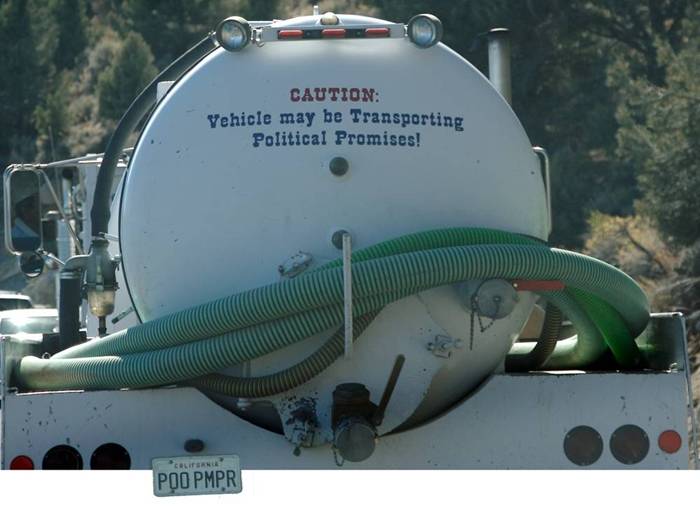
[Picture] A hilarious image that shows the POO that policiticians speak...

I thought this image from dvorak.org/blog was hilarious!!!

Read the caption on the back of the truck (oh, and what do you think of that personalised numberplate!?) poo pmpr...

Technorati tags: , , ,