Saturday
Aug082009
Megie and I at the Springbok vs Australia Rugby test at Newlands
 Saturday, August 8, 2009 at 5:46PM
rugby, great times together! I love you Megie!
Follow me on ResearchGate

Saturday, August 8, 2009 at 5:46PM
Tuesday, August 4, 2009 at 2:38PM Prayer is not a passive pursuit - rather it is an activity that should engage us more meaningfully and powerfully with the realities of life in relation to the God of life! I pray frequently throughout the day in order to maintain a right perspective on God, the world around me, and of course myself. God's presence informs my actions, give me courage and strength, helps me to cope with difficult situations and people, and ultimately directs my destiny.
Prayer always thrusts one out into action sooner or later. One of its main functions is to induce one to think creatively; it stretches the imagination; it enables one to see things and people not as they are but as they might be. - Muriel Lester, social reformer and pacifist (1883-1968)
And here's a verse from Christian scripture to add another perspective:
The only thing that counts is faith working through love. - Galatians 5:6
Monday, August 3, 2009 at 5:00PM We've been having a lot of strikes in South Africa in the last few months - municipal workers, the construction industry, today our national telephone operator and a whole host of other persons have chosen to engage in labour action in order to negotiate a better deal for themselves.
Sunday, August 2, 2009 at 4:35PM What is life's greatest temptation? Think about it for a moment - what are some of the greatest temptations you face? Let's come back to that in a moment.
One of the most perplexing texts in Luke's Gospel, for me at least, is Luke 4:1-15. This is a very unique text for a few reasons.
1. It is one of the only accounts of the sayings and life of Jesus that was not witnessed by anyone other than Christ himself! Think about that for a moment. Just about every other incedent and story in the Gospels would have been witnessed by others, except this one. Yet, it made its way into the Gospels. For those who believe that the texts of the Bible were carefully put together not only by their authors, but also by God, to serve a clear purpose, this is quite remarkable. Jesus must have shared the narrative of these events with a number of persons so that they eventually became part of the 'oral tradition' that informed the Gospels directly and indirectly (through 'Q source').
2. What was the point of the temptation narrative? Well, there could be may reasons for Jesus having to go through this series of temptations. But, perhaps the two simplest reasons were to test his personal commitment and resolve to serving God's will in the world (i.e., he had to show himself to be selfless and strong otherwise he would certainly not be able to face the greater temptations of power (the triumphal entry into Jerusalem - celebrated as 'Palm Sunday' in many contemporary Churches) and safety (taking himself off the cross, or escaping from the Garden of Gethsemane to aviod death). That's one reason. The other reason for his temptation could of course be to show his obedience to his Father's will - God had intended him to understand hunger (a hunger that could not be satisfied by simply turning stones into bread), to understand the struggles with power (particularly the enticing power of evil that esnares so many of us to seek fame and authority by means other than care and grace), and the desire for excitement and the need for safety (many people fear for their safety, and Jesus himself would experience that fear).
So, as I have pondered this text I have come to realise that perhaps one of the greatest temptations that Jesus faced was the temptation of cheating at life. Getting bread without ploughing the soil, planting the sead, tending the crop, harvesting, milling, and baking... You get my point? Work is honourable, and it is part of a complex system of activities that teach us responsibility, stewardship, the value of the resources we work with, our respect for others who do the same task... The list could go on and on.
Jesus was being tempted to cheat at life.
I have faced this temptation frequently in my life! People have tried to involve me in 'get rich quick schemes' (just this week someone called me to ask if I would like to join a network marketting business where the hard work of others would make money for me...) I have often faced the temptation to push my way to the front of the line, to speak when others could make a better contribution, to take credit for the creativity and labour of others... I'm not sure if this ever happens to you? But it sure happens to me.
Don't get me wrong! I have been fast-tracked in my life and carreer! I started in the ministry when I was just 19 years old (almost 20 years ago). I have spent thousands of hours studying and understanding the core of the message of the Gospel. I have many almost as much time understanding the intricasies of the Bible, systematic theology, and the complexity of the human condition. The years of formal and informal learning have helped me to understand the message (the Christian Gospel) and my audience (particularly from the perspective of neuroscience)...
It has been quite a revelation to read Malcom Gladwell's book 'The outliers'. I would truly suggest that you get a copy if you can (ask someone to buy it for you as a gift at your next birthday or Christmas!) Interestingly, I have been reading the book for some weeks now (and bought it as a gift for one or two friends), and this Sunday Malcolm Gladwell will be discussing his books Outliers and Tipping Point on the South African version of '60 minutes', called Carte Blanche.
Here are one or two thoughts (read all the questions and answers on his site) from Gladwell on the concept of the Outliers:
1. What is an outlier?
"Outlier" is a scientific term to describe things or phenomena that lie outside normal experience. In the summer, in Paris, we expect most days to be somewhere between warm and very hot. But imagine if you had a day in the middle of August where the temperature fell below freezing. That day would be outlier. And while we have a very good understanding of why summer days in Paris are warm or hot, we know a good deal less about why a summer day in Paris might be freezing cold. In this book I'm interested in people who are outliers—in men and women who, for one reason or another, are so accomplished and so extraordinary and so outside of ordinary experience that they are as puzzling to the rest of us as a cold day in August.
Here's some input on his research and the suprising findings of his sociological and historical work on success in life:
3. In what way are our explanations of success "crude?"
That's a bit of a puzzle because we certainly don't lack for interest in the subject. If you go to the bookstore, you can find a hundred success manuals, or biographies of famous people, or self-help books that promise to outline the six keys to great achievement. (Or is it seven?) So we should be pretty sophisticated on the topic. What I came to realize in writing Outliers, though, is that we've been far too focused on the individual—on describing the characteristics and habits and personality traits of those who get furthest ahead in the world. And that's the problem, because in order to understand the outlier I think you have to look around them—at their culture and community and family and generation. We've been looking at tall trees, and I think we should have been looking at the forest.
4. Can you give some examples?
Sure. For example, one of the chapters looks at the fact that a surprising number of the most powerful and successful corporate lawyers in New York City have almost the exact same biography: they are Jewish men, born in the Bronx or Brooklyn in the mid-1930's to immigrant parents who worked in the garment industry. Now, you can call that a coincidence. Or you can ask-as I do-what is about being Jewish and being part of the generation born in the Depression and having parents who worked in the garment business that might have something to do with turning someone into a really, really successful lawyer? And the answer is that you can learn a huge amount about why someone reaches the top of that profession by asking those questions.
The simple point that struck me was that we need to be aware of where we can add value (what is there in your context, and in this age of history, that your skills, training, and ability are particularly good at? Please see my second comment on this post for a more details description of these points). Then, once you know where you can add value, don't try to cheat at it! Do your best to hone your craft!
I remember Bishop Peter Storey once commenting in one of our homeletics classes that the sad thing about good preachers is that they neglect what they're good at because it comes so easy to them. So instead of becoming the very best at something only they can do, the slowly drift into mediocrity to take up their place with everyone else who had given up on their passion, dream and gifting. Gladwell points out that people who have been the best at their craft have spent on average 10 000 hours developing their skill!
So, here's a little video that I made where I bring together both Luke 4 and the concept that Gladwell talks about:
And here's a sneak preview of my next Radio Pulpit broadcast (MP3, 6MB) which is a much more detailed exposition of Luke 4 and the temptation of Christ.
I'd love to hear more of your thoughts and ideas about this - also please let me know if you've read 'Tipping point' or 'Outliers'.
Thursday, July 30, 2009 at 9:58PM As the man said!
This is a video interview / discussion with Bill Wasik on Viral Culture & New Media @NextSpace Santa Cruz
Before you jump to the video (and you'd best have some bandwidth to spare - but it is well worth watching), I have been reading Malcolm Gladwell's book 'The outliers'. It presents some fascinating research to challenge our views of success! For example, did you know that the overwhelming number of professional hockey players were born in January (in fact most of them in the first three weeks of January!) Did you know that most of the Tycoons of Industry were born in the 1830's, and that the tycoons of the internet (Gates, Joy, Jobs etc.) were all born within a few months of each other in the 1980's?
The point that Gladwell makes from his research is that 'talent' is only a small part of success. What made all of these aforementioned people a success in their fields was that they were ahead of the curve. Think about this for example, if Gates and Jobs had been just a little bit too young they would never have got ahead of the computer revolution and lead their way into the industry. If they were a little older they would perhaps have been married with kids and so not been willing to take the risks of starting up a new enterprise, and so some other younger, hungrier, more daring persons would have done it instead... Do you see the point? Being aware of where you are in history is an important thing!
There is little doubt that communication technology is absolutely revolutionising the world! The world is not the same as it was even 10 years ago. We can connect at no cost, and in an instant, with hundreds of thousands of people all over the world using a computing device that we can put in our pocket! Text messaging, facebook and twitter are changing the ways in which conversations are structured and engaged...
What is the Church doing about it? We still employ a 20-30 minute sermon as our primary means of communicating the unchanging Gospel to an ever changing world! My goodness that is unwise!
Bill Wasik on Viral Culture & New Media @NextSpace Santa Cruz from Allan Lundell on Vimeo.
I would love to hear your feedback, thoughts and insights! How can we use these tools in our ministry? Do you know of anyone who is doing it well? Do you agree with me that our generation must get 'ahead' of this curve or we may just miss the boat?
Wednesday, July 29, 2009 at 9:29PM From @Liturgy: 30 July is the feast of William Wilberforce, 1833.
Please follow this link for more detail on this remarkable man and his
ministry http://tinyurl.com/n2g56y
We could do with a few more heroes for the faith and the world!
Who do you think would be a contemporary Wilberforce?
Tuesday, July 28, 2009 at 10:32PM For most of this year the parable of of the talents (Matthew 25:21 in particular) has been living within my heart and mind.
Great achievement is worth very little if one cannot be found faithful in the simple things - perhaps Matthew 25, was in part at least, a reflection by Jesus on the different standards of what matters most in life. What the world regards as great is frequently of little value in the Kingdom of God. Conversely what the world has little regard for is frequently very important in God's Kingdom.
I have tried to use this year to cultivate faithfulness in the 'little things'. These include things such as the spiritual disciplines of prayer, fasting and giving. I have been intentional about spending quality time with my wife and children. I have taken my responsibility for my own body seriously by exercising and watching what I eat.
Amazingly I have found a measure of blessing in these things. As I have sought to be faithful in these disciplines they have brought great peace and satisfaction.
The quote below made quite an impact upon me:
Quite powerful isn't it?Every spiritual master in every tradition talks about the significance of small things in a complex world. Small actions in social life, small efforts in the spiritual life, small moments in the personal life. All of them become great in the long run, the mystics say, but all of them look like little or nothing in themselves.
- Joan Chittister
The reality is that it will take some discipline and courage to go against the grain; to choose not to conform to the norms of a largely secular society. To be deeply connected with Christ may even require that one goes beyond the traditions and conventions of your Church community.
If you're interested in reading a more in-depth example of one person who did this you're welcome to download a free copy of my book 'An uncommon spiritual path: The quest to find Jesus beyond conventional Christianity'. While this particular approach will not appeal to everybody, I do hope that as you read the pages you will see something of the courage that it took for Henri le Saux to go beyond the commonly accepted traditions (and even doctrines) of his faith to develop an authentic relationship with the person of Jesus Christ.
I'd love to hear your feedback!

http://www.spirituality.org.za/books/Uncommon_Spiritual_Path_Forster.pdf
Here is some more information about the book from my website - you can order a copy of the book here if you would like to own one on your shelf.
Rich blessing in your daily spiritual discipline. Remember to be faithful in the 'small things'!Are you tired of 'consumer' driven religion? Are you finding that the 'popular' steps to faith no longer satisfy your desire for true spiritual living? Then the novel and courageous approach of this book could be just what you have been longing for.
The truth is that people cannot be whole unless they have an active and deep spiritual life. One of the great shortcomings of many contemporary western cultures is that they lull us into believing that we can find peace, joy, and fulfillment in what we own, or in what we do. Sadly, many people have come to discover that the pursuit of wealth, power, and recognition by one’s peers, are shallow and meaningless against the backdrop of what it means to be truly alive. When one considers that a human person has physical, psychological, and spiritual needs, the pursuit of true and ultimate meaning becomes all the more important in a world that seems so increasingly devoid of depth.
This book charts a different course to the norm. It examines a way of life that may seem quite austere and strange to most of us. However, it will be shown that it is not the spiritual methodology, or even the content of this particular spiritual path, that brings blessing and peace. Rather, it is passing beyond methods, ideas, and even doctrines, that brings us into the presence of the God who gives and sustains true life; the kind of life Jesus speaks of in John’s Gospel (John 10:10)
This book charts this uncommon spiritual path by examining the 'non-dual' spirituality of Henri le Saux (Swami Abhishiktananda - meaning 'the bliss of Christ'), a French Benedictine monk in India. His approach is challenging, courageous, and even unsettling in some instances. However, his deep commitment to finding Christ is an inspiration.
Monday, July 27, 2009 at 10:06PM 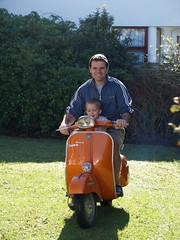
Yup, this is the cheapest, and most fun way to travel in the current economic recession!
This picture was taken in my back yard (yup it is large enough to ride my Vespa - you just have to watch that you don't ride into the pool! ha ha! No, it's not that dangerous!) My Vespa, Mertyl, is a 1967 Vespa VLB Sprint 150cc - it was wrecked in an accident in February 2008, but thankfully I had it restored and it looks as good as new!
Man, I love my boy and my Vespa!!!
Enjoy life and be blessed!
Dion
Sunday, July 26, 2009 at 11:37AM Have you noticed that Lions never go on a hunger strike! This post will tell you a bit more about that - you see it comes down to consciousness and choice. These are but some of the privileges of human sentience... Read the post below for more detail on these thoughts, and if you feel like it, download the audio recording for a different perspective on freedom, choice and mediocrity.
Being blessed and being a blessing! A sneak preview of my next Radio Pulpit broadcast. You can download the MP3 recording here (6MB).
So much of life is about choices. I find that I can so easily slip into mediocrity. Do you struggle with the same? I either slip into the routines and expectations of my context - simply responding to the most urgent and necessary things that are taking shape around me each day. It would seem that Newton's laws of motion apply to so many aspects of reality! Inertia is a very powerful force in movement. It takes a lot of energy to break free from the direction in which one is traveling (or not traveling) at any moment. My studies in neuroscience have shown a similar trait in the manner in which our brains (perhaps the most powerful organ in our bodies) operate. The brain is not only geared towards survival (see this post for more on the three basic questions that all human brains operate on). Rather, it is geared towards the conservation of energy as a means of survival. Since energy is a fundamental aspect of our physical survival our brains make all kinds of choices (some that we're not even aware of) in order to ensure our most likely survival in a world of pressure, choice, and obstacles.
Think about this, your brain will increase or decrease your body's temperature, slow or increase your heart rate, and at times even cause you not to hear, see or smell things in order for you conserve energy and survive (women call it selective hearing, us men call it survival! ha ha ;-) But there are many other examples of how our brains, a part of our own bodies, fit into the wider set of systems that make up life in and around us.
Of course unlike animals we humans have the power and ability to control our bodies and minds. Have you ever noticed that Lions don't go on hunger strikes? Only humans have the capacity to consider what is MORE important than the momentary urges of survival. So, we may choose starve for some greater cause - of course even that often comes down to the survival of the species (if not our own survival, then at least the survival of our kin and kind).
We can choose! We can choose to become conscious of what truly matters in life. We can choose to become conscious of ourselves and others, and we can adjust our choices and behaviour in order to do more than just what is necessary! We can do what is Christlike, and in so doing find blessing and be a blessing.
So, the reality is that it becomes easy to just 'go with the flow'. The Philips translation of Romans 12:2 says something like 'Be careful that you do not get squeezed into the mold of this world'.
Energy, that's what it takes to be more than just ordinary! It takes a few radical choices, a few small victories, and a couple of little course adjustments and changes to begin to gain mastery over your life, your context and the 'mediocrity' of the world. We can choose to be more than just ordinary.
In this radio recording for my radio show on Radio Pulpit I discuss this notion in more detail.
I would love to hear your thoughts and feedback!
Rich blessing,
Dion
Original Tweet: http://twitter.com/digitaldion/status/2754585458
Sent from http://www.twitter.com/digitaldion
Friday, July 24, 2009 at 11:47AM Here's a short interview that my friend Shane Vermooten from Media Village did with me for their series 'On the Orange Couch' at the School of Video Production in Kalk Bay in Cape Town.
In this video I discuss some of the issues related to how we can harness new media in Christian ministry. I also discuss some theological perspectives in the mission of the Church and of individual Christians in society as they relate to the Kingdom of God.
Find more videos like this on SVP 2009
Please share any thoughts and feedback!
You can find my original video, powerpoint slides, and post on new media in ministry on this link.
Wednesday, July 22, 2009 at 10:32PM One of the greatest personal struggles I face is the struggle of self-determination. I face a constant battle between the things that matter, and the things that matter most.

