Search

Follow me on ResearchGate

Follow me on ResearchGate

Pages
Social networking
Tuesday
Dec012009

An HIV+ Church in an HIV+ world - Positive in prayer


Today is World AIDS day. Today we remember that the Church has AIDS. We do not minister to people who are HIV positive, as if they were people outside of the body of Christ. Rather, we ask God to heal us, for all of us suffer from this disease.

Whether you are HIV+ or not, this disease reminds us that we shall all face death. It reminds us that we shall all be ill at some stage. It reminds us that we need one another to be strengthened and encouraged to face the reality of struggle. It reminds us that society can be cruel and that people can be judged for something that afflicts them. Most of all, this disease reminds us that we have a God who cares and longs to bring us healing and hope.

Prayer of invocation:

Loving God, you are our parent. You look upon us with mercy and compassion. You understand our weakness. Our suffering breaks your heart. Look upon us with love, grace, and compassion today. Father, you know the pain of losing your only son to death. Jesus, you know the pain of dying and leaving those whom you love behind. Spirit you are the giver and sustainer of life. With confidence we approach your throne of grace that there we may receive mercy.

Renew our spirits and draw our hearts, bodies, and minds close to yours. All of us are subject to the frailties of life. Strengthen us in our weakness, bring us wholeness in spite of disease. For those who live under the impending threat of death, offer them comfort and strength in the knowledge that death does not have the final victory and that in you there is true, eternal, and blissful life that lasts for eternity. For those who feel the pain of seeing a loved one die, fill them with courage through the power of your Spirit of life. Surround them with caring and loving people who will show to them the love that you want to give them in their time of need.

Help each of us to strengthen our resolve to obedience and service. Give us courage so that we would not shy away from facing our own frailty and pain. Move us to go to the places of death, like your beloved disciple John went to your cross, so that we may offer love and healing to those whom you love.

Let us delight in doing those acts of mercy that will bring healing and honour Your name.

Today we declare the faith that neither height, nor depth, neither life, nor death, neither angel, nor demon, nor anything in all creation can separate us from Your love. You are the creator God. You make a way where it seems none can be found, your bring forth living waters in the wilderness. We place our trust in You, through Jesus Christ our Lord. AMEN

A meditation to guide your prayers and actions today


Nosipho's story - no greater gift.

Nosipho is just thirteen years old - tonight she is lying awake next to her 8 year old brother and her 5 year old sister. Her father named her Nosipho when she was born. She remembers that tonight. Her name has a very special meaning. Nosipho was born to her proud parents, Mxolisi and Vuyisile, in a remote part of South Africa called northern Kwazulu Natal. There was no work there for Mxolisi so he went to the city to find work as a labourer working on the roads. Mxolisi wanted to live a good life and take care of his family as best as he could. So, he faithfully brought money back to his Vuyisile and Nosipho at every opportunity. He and Vuyisile were blessed with a son who they named Andile (meaning 'the family is growing'). They loved their children very much and had great dreams for their future.

However, with each year that passed it became more difficult for Mxolisi to be alone in the city. The months that Mxolisi and Vuyisile spent living apart took a toll upon their marriage and they would often disagree and argue. Once, when they argued, he told her that 'he had needs', 'like all men do'. And so, he decided to take a 'city wife', as many of his friends had done. Sadly, his city wife was HIV+, and so when Mxolisi returned home one December, himself HIV+ by this time, he gave Vuyisile another child, Thandi (which means 'nurturing love'), but, he also gave her the killer virus that would take both their lives.

Mxolisi and Vuyisile discovered that they were HIV+ in the year that Nosipho turned 8 years old. Andile was 5, and little Thandi was just 2. Thandi had already been infected with the virus her mother was carrying through the milk she drank from her mother?s breast. Sadly, both Mxolisi and Vuyisile died of AIDS within 3 years of discovering their status, Thandi, however, is still alive and now a little girl of 5.

Nosipho is a clever little girl. However, she hasn't been to school since her father died when she was 11 years old. By that stage her mother was already very ill and confined to bed, but at least then Andile and Thandi could stay with their mother while Nosipho begged for food and money at a traffic intersection on the edge of the township. She watched the other children going to school dressed in their smart school uniforms, with book bags that had pencils, paper, and no doubt some lunch to eat. She wished that she could be like them, but that would not happen - her mother eventually died as well.

Tonight as she lay in bed she was no longer a child, but a parent, overnight she had become a 13 year old head of a household of three. She knew that she had a much greater responsibility than other 13 year old children. Each day she has to get enough money from the cars and commuters that come whizzing by to feed her two siblings and herself. She has a small cardboard sign on which she has written in a child's handwriting 'No parents, no food, no work, 3 people to feed. Please help. God bless you'. She also needs to get a few rand extra every month to help pay for Andile's school fees. She wants him to stay in school and learn so that he doesn't have to suffer like his father did. She doesn't want him to suffer like she is suffering now. Whatever money she has left after she has paid his fees, when there is any, is given to the 'aunty' who looks after her sick sister, Thandi, while Andile is at school and she is begging at the traffic lights. She doesn't trust the aunty, she drinks, and she's sure that she hits Thandi. But, she has no option. It is too dangerous for Thandi to be with her at a busy traffic intersection.

There are other girls like Nosipho. In fact most of the child headed households in South Africa are headed by girls under the age of 15. Nosipho knows this because she meets some of them every Sunday at a little group for children like her that is held in the tin church near her shack. They sing songs, some kind ladies read stories to them from the Bible, and then they say prayers and get some food to eat. The church has also given her clothes and shoes for her and for her brother and sister. There is a lady from the government clinic who comes to visit their group once a month. She always asks Nosipho if she is safe, and asks if she and her brother and sister are getting enough to eat. You see, Thandi needs special medicine to keep her healthy, but she can only take her medicine if she eats properly, or else the medicine will make her sick instead of healthy. So on days when Nosipho does not get enough money, or food, to feed all three of them she lets Thandi eat first, so that she can take her medicine. Andile eats next, because he can't learn when his stomach is empty. Nosipho often lies awake at night hungry, but she knows that she is a 'gift' from her parents to Andile and Thandi ? that?s what her name means. Nosipho means 'a gift'. It?s the name her father gave her. She doesn't play anymore, she simply lives to be a gift to her brother and sister. Tonight she prayed to ask God to help her because a man has said he will give her R20 if she takes her clothes off and sleeps with him. She's praying because she is afraid. She has been told at church, and she has seen the posters, and heard the stories - Nosipho knows that's how little girls get sick and die ? but she needs the money. She wants to be a gift. She doesn't know what to do. Maybe God will do something to help her tomorrow? It is Sunday, she will ask one of the ladies to help her.

Reflection: Stories such as this are common in South Africa. In KwaZulu Natal the death rate is higher than the birth rate because of AIDS. Recent statistics from UNICEF have suggested that up to 50% of children are HIV+ and an increasing number of children are growing up without their parents. Children like Nosipho face a stark and dreary existence. They are robbed of their childhood and dignity in a quest to survive. Very often their only support comes from community organisations such as churches and civic groups. For most children the lack of access to food, or poor nutrition and feeding practises, coupled with infection, leads to their untimely death. Children who are born in rural areas who do not have 'bar-coded' South African Identity documents do not qualify for medical care, schooling, or any form of government grant. Sometimes the most basic of help, like helping children register for an ID Book, or offering children a daily meal, and seeing that they take their medication can mean the difference between life and death. Methodist Churches in Southern Africa train all of their ministers to offer support and care to persons who are infected and affected by HIV. It is a central part of their training for ministry. In the region of the world that has the highest rate of HIV infection it cannot be any different. The Gospel demands that we bring healing and transformation. Perhaps the work of the Church near Nosipho could keep her from turning to prostitution at the age of 13? All that is needed is a courageous group of caring people who will see her plight, understand what she needs, and help her to find it - food, shelter, and loving adult support. This is what Jesus would do.


[I wrote this story as a case study for a book that is in publication in the Cambridge Theological federation, UK. Please do not copy it without contacting me. I shall put you in touch with the publishers to get permission. Thank you.]

Silent reflection and prayer.

  • What do you feel? What do these feelings tell you about yourself?
  • What does this story tell you about the world, and others in the world?
  • What do you think God feels? What would God want you, or your Church, to do?
  • Knowing this, what do you need to pray to have the courage to do?
  • What will you do today? What will you plan to do tomorrow? What will you want to achieve by next year this time?
A benediction for today

Almighty God, by the power of your Holy Spirit open my eyes to see the world as You see it, my ears to hear the cries that You hear, my heart to have the courage to feel what You feel, and my life to be present to You and all those whom You love this day. Give me the courage to worship and serve you in faithfulness, to be a blessed and healing reminder of Your love to all whose lives I will touch. I offer this prayer in the name of Jesus Christ, to the glory of God the Father, and in the power of the Holy Spirit. AMEN.


If you're looking for some facts on HIV / AIDS here are a few that may be of interest:


Have you ever taken time to consider the relationship between faith, economics, globalization and the suffering of people?

Well, recently I did a post about the neurological causes of greed, and how these can be managed as a 'value transaction' in order to address some of the economic inequalities that we face across the world.

Let me show you a few basic analogous maps of the world to illustrate the economic inequalities that exist in the world.

First, here is a basic map of the world based on geographical land mass (i.e., this is the traditional manner in which maps are drawn - the area of each land mass is a represented equivalent of the actual land mass drawn to scale).
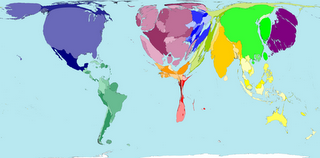
Now, take a look at this next map - this map is analogous of the world's wealth. In other words, the more wealth a nation has the larger it will appear on the map. Look how large North America and Europe are in relation to the rest of the world - it is also worth noting how rich Japan is on this map. Clearly, the world's wealth is concentrated in the Northern Hemisphere, and it is largely concentrated in the West. I shall, however, say something about the shifts that are taking place in the world's economy at a later stage.
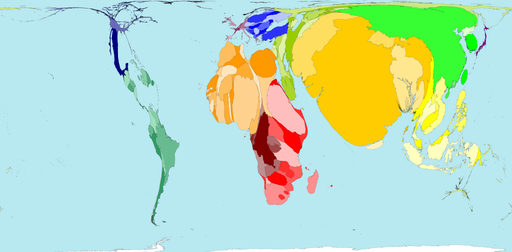
Next, take a look at this map which analogous of poverty across the world. It is almost an inverse representation of the wealth map above - this map shows nations that are poorer as larger masses on the map.
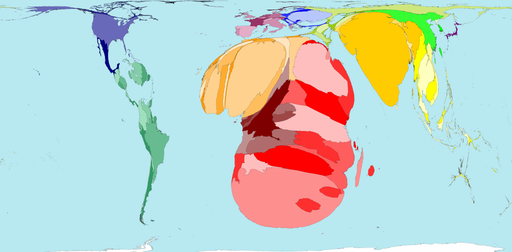
Now, take a look at this map which shows HIV / AIDS infection across the world - it is interesting to note that 68% of all HIV+ people live in Southern Africa (that is 22.8 million out of the 33 million persons who are HIV+). I have just written a study on this for a new book on a Christian response to HIV / AIDS - it is shocking to see the prevelance of AIDS deaths in Africa. But please do take a look at the last map in this series.

This last map gives an analogous representation of where the world's Christian population lives. Isn't it sad to see that Christians live in most of the places where wealth, poverty and HIV / AIDS are significant problems? Clearly we have a few things to learn about money, God's economy, health care, reproductive care, women's rights, and sex!

OK, now I made mention of the fact that the world's wealth is concentrated predominantly in the North and the West - this is changing! Within the next 10 years the economies of the USA (North America), and most of Europe will show negative growth in some instances, and decline in others. The economies that are on the rise are China, India and Brazil (Australia is also a Southern Hemisphere economy that is growing at a significant rate). In other words, by 2020 we will see a completely different picture in global economic power! My advice is that you send your kids for a 'gap year' in China! As for me, I'm starting to study Mandarin!

If you're interested in a more detailed discussion of these shifts you can read this paper that I wrote for the Stellenbosch University Business school in 2009.

Sadly, Africa's economy will only show marginal growth since it is crippled by the impact of AIDS, political instability, underdevelopment and international debt. However, if we play our cards carefully the continent could be the next economic powerhouse after China and India since we are one of the only continents on earth that still has natural resources!

So, here's the point - did you realise that if we spent just 10% (190bn US$) of the annual world budget for military expenditure (1235bn US$) we could BOTH restore the earth's natural resources (cleaning up our water, replanting trees, creating environmentally friendly and more sustainable energy source), AND meet the basic water, sanitation, education and health care needs of the whole world! Just 10%... You can read about that research from Brown 2008 (entitled Plan B 3.0: Mobilizing to save civilization) here.

Christians make up more than 40% of the world's population - surely we could take up our responsibility to manage the 'household of God' (oikos nomos - economy) for the transformation of the world?

What do you think? How do we do it? What practical steps can you suggest to start making a difference within your sphere of influence... As I've been doing this research in recent weeks I've been praying one text consistently:

The earth is the Lord's, and everything in it, the world, and all who live in it. (Psalm 24.1 NIV)


If you're interested in an article / chapter that I have published on the subject of the environment and earthkeeping you can read

  • More red than green ? a response to global warming and the environment from within the Methodist Church of Southern Africa. Forster, DA in The Epworth Review - the Journal of Methodist ecclesiology and mission Vol 35, No 2 (2008). This paper was also published in
  • Forster DA, 'More red than Green', in What are we thinking? Reflections on Church and Society from Southern African Methodists. Forster, DA and Bentley, W. 2008. Methodist Publishing House, Cape Town. ISBN: 978-91988352-6. (2008:117ff. Chapter 7)

(This is not my area of expertise by the way, I am far more interested in justice and economics, but there was not much being written on this topic from our perspective so I took it upon myself to do some research in the area).

If you're interested in reading a chapter that I wrote on the Christian's response to Greed and Economics please see:

  • Upon the Lord's sermon on the mount - discourse 8 (a contemporary exposition of John Wesley's sermon on stewardship and the use of money from an African Liberation Theology perspective) in Shier Jones, A and Reisman, KD 44 Sermons to serve the present age (2007), London: Methodist Publishing house. ISBN: 97807162063

Oh, and if you're looking for my 'other' post on maps of the world please go here. This is the MOST clicked linked on my blog - isn't that amazing!?

For more posts on HIV / AIDS please follow this link.
Wednesday
Nov252009

Work as worship... AND Charles Wesley.

Those of you who watch my little videos or listen to 'The Ministry and Me' (the radio show I do on radio pulpit, see http://www.radiopulpit.co.za , and sometimes repost here) would have heard me saying that 'work can be worship'.


I do believe that EVERY activity should be directed towards honouring God.  

The false dualism between sacred acts and secular acts is not in keeping with the faith of the Bible!  God is the God of all of life, there is no part of life that God does has no interest in (double negative... I know!)

I've had a few people contact me to say that we must not worship work.  I agree with that wholeheartedly!  But, how we do our work, what we do without the hours of our workday, and how we establish God's gracious, inclusive, and transformative Kingdom within our work lives can transform our tasks, energy and creativity in acts of declaring the worthiness of the God who sets us to our daily tasks (or at very least sustains us through them!)  Col 3.23-24 speaks so clearly of this, that we should work as if we're working for Christ.  

As a signatory of the Unashamedly Ethical pledge form (see http://www.unashamedlyethical.com and have a look at the individual pledge form) I have committed myself to working diligently and wholeheartedly.  Sure, this will please my employer.  But, sometimes it will not!  My diligence is to Christ!  So, if I am required to do something, or behave towards someone, in a way that is inconsistent with the principles of God and God's Kingdom then I shall choose the more worthy way, that is, the way of Jesus.  I rise early and go to bed late, and yes I am productive and careful.  I am a good steward and I hope that I am a valued servant.  But, ultimately I put my hand and my heart to the tasks of the day for the sake of serving Christ.  I can live (and die) for that!

This quote, from Charles Wesley (the hymn write and brother of John Wesley, the founder of Methodism), offered me encouragement in my daily task.

Forth in thy name, O Lord, I go,  my daily labor to pursue; thee, only thee, resolved to know in all I think or speak or do. Charles Wesley, from his hymn "Forth in Thy Name, O Lord"

As always I would love to hear your perspectives, insights, and feedback!

Wednesday
Nov252009

How should Christians respond to personal conflict and anger?

I'm not sure about you, but I often find it difficult to remain 'Christian' in the face of conflict and anger!  I am a passionate person (that's a gentle way of saying that I am still praying about my temper!)


I often get persons contacting me from my radio program on Radio Pulpit - http://www.radiopulpit.co.za asking about this issue.

We'll here's some insight from the Bible - How should Christians deal with conflict and anger.  I would love to hear your ideas and feedback!  Be blessed!


Tuesday
Nov242009

Are you saved? An Orthodox perspective

A few friends sent me this incredibly thought provoking video. I love the one particular line that says 'I am being saved daily'. I was saved when Jesus died (justification), but I am still 'living towards' that reality (sanctification).

I was challenged by this video!

What are your thoughts on salvation!? I recently wrote a chapter on the scourge of HIV/AIDS in Southern Africa in which I asked the question 'What does it mean to be saved when you are HIV+ and poor?' Surely it is something different from what it means to be saved when you have an income, a home, and good health?

I'd love to hear your thoughts!

____

Mark Penrith asked such a great question, that I thought I must elevate his question and my response to the actual post (just in case anyone doesn't open the comments!)

Thanks Mark!

OpenID markpenrith said...
Salvation is not a relative position. You either are or you're not. Salvation is not a temporal status tht you can fall into and fall out of. It also doesn't differ based on economic, social, ethnic or ... reasons. It's objective, measurable and positional. Have I missed the boat.
5:19 PM
Delete


Blogger digitaldion (Dion Forster) said...
Hi Mark, Thanks for the reply!It is always great to hear from you!I don't think you've missed the boat. However, I do have a question and a comment to make. First the comment - Indeed, I agree that within the ordus salutis (the order of salvation) the most critical element of the order, salvation itself, is entirely dependent upon our Gracious God. That is unchangeable since it is always the same (it is a salvation from something towards something else - this is the Biblical perspective of both Jesus and Paul). In most instances it is expressed as salvation through Christ from sin (and that sin is separation from God the source of life and love) towards reconciliation with the God who is the source of all true life and love.Traditionally we, as Protestants, have believed that this is the second step in the order of salvation. It is called justification. This step is entered into when we respond to the first step (previnient grace, or 'preventing grace').Step one is where God convicts us of our sin and we have the good sense to respond to that loving conviction in repentance (turning from sin towards God).Then, the second step is the act of justification (a term coined by Paul, used particularly in Romans) in which God saves us from the sins that enslave us. However, there is a Biblical distinction between being saved from the sins that enslave us, and Christ overcoming sin! Jesus overcame sin and death (according to 1 Corinthians and Romans) when he died on the cross and rose form the dead - in that sense salvation took place 2000 years ago and it is unchangeable! It is that reality that makes the first step in the order of salvation possible! However, the second step (being saved from the specific sins that enslave us today), justification from sin, that could differ from context to context! The sin that I struggle with may be different from the sin that enslaves you. Jesus sets me free, today, from that specific sin. Then there are traditionally two more steps in the order of salvation.Step three is growing in grace, 'working out our salvation with fear and trembling' as Paul describes it to the Philippians - [it is also called sanctification]. This is very much a context based thing! Yes, it has to do with an internal spiritual state of purity and holiness (being sanctified, or set aside), but it requires daily turning from the specific things that enslave us. This could be anger, bitternerness, hatred, abuse, fear, stigma (whatever is not of God).The final stage is entire sanctification - this is an unchanging element of salvation. So, I would say that of the four steps, one and four are immutable. They are entirely God's sovereign work. Steps two and three are relational, God in God's grace allows us to respond to God's power and love and so these are personal (or at least social) and they have a contextual element to them. Does that make sense? Be blessed! Dion
Now, I never got to the question I said I would ask of Mark (comments are only allowed to be a certain length on blogger!) The question I would ask is 'what does it mean to be justified and sanctified in South Africa today?'  I know that salvation means to be saved from our sin, and that the end state is an entirely restored relationship with God the creator, but form what sins do you and I need to be set free, and what do we need to turn away from daily in order to grow closer to God and the rest of God's creation?  I can assure you that it will be something different from what the person in Darfour faces, and different still from the person in New York, or the person in China.  The beginning and the end are the same, but the bits to which we are called to respond differ radically.  Don't you agree?

What I forgot to mention is that I have written about the Order of Salvation (repentance -> justification -> sanctification -> entire sanctification) in my little book Wesleyan Spirituality - An introduction  (Forster, DA 2001, Cape Town, Methodist Publishing House).

Thanks once again Mark

Friday
Nov202009

Qik - Reflection 20 Nov 09 when the poor are glad.. by Dion  Forster

Tuesday
Nov172009

The Church, where people are turned to God, or turned away...

I found the following quote extremely challenging.  I am acutely aware of the importance of the 'local Church' as a community to sustain and support believers.  However, it is also intended to be place from which God's love is sent out into the world and communicated in tangible and accessible ways.


Today I met with a person who is doing incredible work in his local community, but he has not been into a Church since 2001 when his pastor had an affair with various women in the community, and one of the other pastors stole millions of Rand.

Indeed, this is the dichotomy of the Church community in the world...  It strives for perfect love, but frequently it falls short.  I still believe that the local Church is a central part of God's plan for the transformation of the world!

Here's the quote!

The Christian faith for most people is not communicated by doctrinal pronouncements ... but by what goes on in the church in its most local setting. It is here, in the church down the street, that people are caught up in the Gospel promise -- or are turned away.James C. Fenhagen, from his book Mutual Ministry

Tuesday
Nov172009

My struggle with our world... and the blessing of God's grace.

My life is shaped by various 'framing events' - some are much more arresting than others.  


Yesterday as I was driving to a meeting I stopped at a traffic light (strangely we call traffic lights 'robots' in South Africa... I'm not sure why!)  Seated just next to the traffic light was a street child.  There are many such children in South Africa, some are forced onto the streets because their family simply cannot afford to care for them, and so they beg for food and money.  Others are forced onto the street because of abuse at home, and there are many thousands of young children living on the streets because they have lost both their parents to HIV/AIDS.

I had only glanced at the young boy sitting next to the traffic light, as so often happens my attention was wrapped up on other things.  I was thinking of the meeting that I needed to get to, keeping an eye on the oncoming traffic so that I could find a gap to turn, and listening to the radio.

All of a sudden I noticed a minibus (we call them Taxis) slowing down as it approached the traffic light.  Suddenly the driver thrust his arm out of the driver's side window and threw and empty Coke bottle directly onto the child's head! I was shocked!  I still cannot understand what would make a person so callous and uncaring that they would slow down their vehicle in traffic and intentionally harm an already suffering child.

I stopped to see if the boy was OK.  He was, and of course he used this opportunity to get some money from me.  Feeling emotional I gave him a few Rand.

However, for the rest of the day I felt bruised.  I was bruised by the brutality of human nature, and bruised by the fact that I live in a world in which children live on the streets, a world in which people like me spend their lives rushing to meetings, a world in which someone would deliberately seek to hurt a child.

This morning as I turned to my devotions the following prayer brought me some comfort and hope:

Almighty God, send the light of your Son into our lives anew today.  Let your presence touch our minds and hearts with your mercy, grace, and truth.  Direct our thoughts, speech, and steps to the end that we may walk in your ways today and always.  In the name of Christ.  Amen.

Monday
Nov162009

Priase be to God! Liam (the great) turns 3!!

It was three years ago today that Liam entered this world!  How wonderful it is to celebrate his 3rd birthday!!!!

The 15th of November was one of the most difficult days of our lives as Megan went into labour for the third and final time, then just 27 weeks into her pregnancy.  She had been in hospital for about two weeks since she first went into labour after falling ill in her 26th week of pregnancy.

On the that evening I had just arrived home with Courtney after visiting Megan in hospital when the phone rang and the doctor asked me to come back as quickly as I could.  I took Courtney to our friend Madika's home and raced back to the hospital where Megan was already in the delivery room.  An hour or so later little Liam entered the world at barely 1kg. 

Naturally we were overjoyed at his birth, but we knew that we had a journey ahead of us.  As Megan was wheeled into surgery after the birth I stood by as the doctor and nurses prepared Liam to go into the intensive care unit at Pretoria East hospital (the neonatal ICU).  He was so tiny and fragile. 

Well, you can follow some of the story here, and some other bits here.


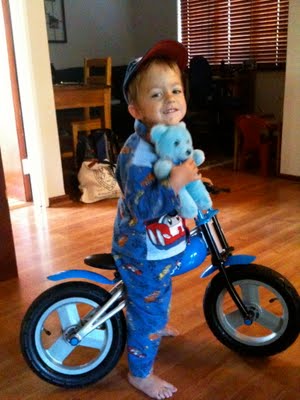
About a week or so after Liam's birth we took this picture of him with this tiny little teddy-bear.  Look how small he was!

We prayed through the day and night, and had many wonderful friends and family praying with us!  Liam remained under the wonderful care of the ICU unit for almost three months.  They were truly wonderful, not only caring for him medically and for us emotionally, but they even worked out a way to help us when our medical aid funds ran out two days before Christmas!  The hospital and doctors negotiated a reduced rate so that we could keep him in the ICU.  It was truly a magnificent Christmas gift!

Of course there were the many friends, like Wessel Bentley and his wonderful congregation who helped us to cover the almost quarter of a million rand shortfall that we had for his medical expenses.  Between our friends, and an extension to our home loan we were able to cover the costs entirely and soon Liam was at home growing at a rate of knots!!!

There have been a few little moments inbetween, he has been in hospital a few times (as you'll see from the links above), and we still have to pay some attention to his physical and cognitive development.

But, these little hiccups are not even worth considering in comparison to the joy of his life!!  He is growing up to be such an incredible little guy!  He has a wonderful sense of humour, he roughs it with the best of them (climbing, running and jumping), and like his dad, he loves his bicycle!

We were cautioned to expect the worst, and we are thankful that we have only been blessed with the very best!


Here's an updated photograph of our little miracle boy taken this morning... Just look how much he has grown in relation to that same little blue teddy-bear!!

Today Liam turned 3 years old, and we give thanks to God for the gift of his life! 

Courtney and Liam are the most precious gifts we have ever received!  Please take a few moments to give thanks to God with us for Liam, and perhaps also to thank God for your children.

Friday
Nov132009

A new pony in the Forster stable. Has 91 000km's under the belt, but was affordable & good condition!

--
This message has been scanned for viruses and
dangerous content by Pinpoint, and is
believed to be clean.

Wednesday
Nov112009

A reflection on the partnership of missional congregations conference with Pat Keifert

This week I had the rare opportunity to attend an academic conference in my home town (Somerset West!) - the conference was the 5th anniversary conference of Churches in mission - attended by cluster Churches that belong to the missional Church movement.

First some personal background - I was humbled and deeply honoured when Dr Coennie Burger approached me a few weeks ago to join BUVTON at the University of Stellenbosch as a research associate.  The University and the Institute have some plans that will unfold in the next little while, so do keep an eye on this space.  It is a joy to be associated with BUVTON and with the faculty of theology at the University of Stellenbosch since this was where I first began my doctoral studies, and I have many friends in the faculty.  Moreover, the faculty has been very kind to me over the years (allowing rights to the library, giving me classes to teach, and inviting me to various conferences and events).

I still hold an adjunct post in New Testament at the University of Pretoria (working as an associate to honorary Professor Jan van der Watt who is now at Nijmegen in Holland).  And, I was nominated as a research Fellow for the Institute for the Study of Religion at the University of South Africa earlier this year as well.

Each of these posts caters to different interests - the value for me is that they keep me keenly connected to the academy, and the value for the various partnerships is that they get the benefit of my research output (each time I publish a scholarly article, present a conference paper, do book review for a journal, or write something in a book it adds value, and sometimes funding, for them).

So, Dr Burger and Dr Frederik Marais invited me to the abovementioned conference under the auspices of my partnership with BUVTON. I was truly thankful that it worked out that I could attend the conference since I had booked out some time for a conference that I was supposed to attend first in Argentina, but then when it moved to Hawaii (to cater for North American delegates) the cost made it impossible to go.  My boss did however go, and it meant that my diary was miraculously open!

The theme of the conference was 'Living as sent ones:  Congregations participating in God's Mission'.  It was such an uplifting and informative time for me!

The first most significant feature of the conference was the daily pracise of 'dwelling in the word' - I had read about the method in the past, but the simplicity of it had never appealed to me.  However, experiencing, and participating with others, in this spiritual discipline was truly a transformative personal experience!  Here is a brief explanation of the approach:

Church Innovations has the habit of text dwelling. That is, whenever we meet, as a staff, as a work team, as a training group, we spend the first 20-30 minutes, sometimes more, dwelling within a particular scriptural passage. For us, most of the time, the text is Luke 10:1-12. It is a text of mission, of being sent out with the most basic of instructions, dependent upon our receivers’ hospitality....


You can have this habit, too.

  • Choose a passage - perhaps a lectionary text for this coming week, perhaps a passage already meaningful to your group, and read it aloud.
  • Sit together with the passage, in silence, or in conversation, sharing with one another where your imagination was caught or where a memory was triggered. Let the passage draw you together as a group.
  • Bring the passage up when you're trying to make a decision. See what it says to you then.
  • Close with the passage and prayer.
  • Bring up the passage again during the next meeting, in the same manner.
  • Live in the passage for several months. It will bring more and more to you as you revisit it (at Church Innovations we have been living in Luke 10 for over ten years now).

The particular text for this conference was Luke 24.  As a Biblical scholar I was constantly tempted to work with the technical elements of the text (historical background, grammatical and syntactical clues, the narrative style and construction of the narrative etc.)  However, the intent of this approach is to create a hospitable encounter with the power of the text, and to learn from one's own experiences, and the experiences of others.  This approach takes seriously what I have discussed in two recent books I have written for (see my chapter on Biblical interpretation, spirituality and postmodernism in 'What are we thinking' by Forster and Bentley 2009, and also my chapter in 'What is a good life?' by Bentley, Kretzschmar and van Niekerk 2009).  In both instances I discuss the value of approaching the text with an open recognition that we do so from a particular perspective (this is not only based on theological bias, personal experience, and socialisation, it is also influenced by our needs, our struggles and our desires).

The second, and equally wonderful aspect of the conference was the narrative approach to sharing 'stories of mission'.  I guess there were about 100 or so participants at the conference.  They came from as far as Malawi, Namibia, Zimbabwe and all over South Africa.  The participants shared stories of how mission was being shaped in their context through an openness to what God is doing! This approach speaks of trust in God, rather than merely crafting a mission strategy.  It speaks of harnessing the move of God's spirit by dwelling in the word and seriously dwelling in the world.  These two things go hand in hand.  Scripture and context.


Various inputs were encouraging and inspiring - but perhaps the most remarkable for me were some conversations with old friends (like Prof Klippies Kritzinger (more of a mentor than a personal friend), Dr Breda Ludik (a friend I have known for years in the Helderberg who is doing some incredible work in spirituality), and Prof Pat Keifert (a new friend - I had read some of his works such as 'We are here now' (2006), and most notably 'Welcoming the stranger' (1992). You can find out more about Pat here)

Pat is the founder of the movement for missional Churches.  His theology and approach to being in mission (as a participation in the mission dei (mission of God)) resonates so strongly with my own perspective.  Moreover, he is a stringent and supremely well read Systematic Theologian, so his thoughts are 'tight', clear and orthodox.

Dr Frederick Marais summed up Pat (and the movement's) approach to being in mission as follows - true mission involves a series of conversions:

1.  From the Church to God.  Ultimately the reason for being and particularly being in ministry and mission is NOT to grow the Church, or perpetuate a structure. True ministry and mission is about a sincere and deep journey with God, along God's way in the world.
2.  From ideas ABOUT God to a journey WITH God!  The thrust of the missional movement is not theology (as such), the greatest value comes not from knowing things ABOUT God, but rather from lovingly and faithfully journeying WITH God (i.e., Knowing God and God's ways and responding lovingly to God's guidance and instruction).  This can lead one among strangers quite quickly!  I came to realise how this is the case for me.  I am minister in a corporate environment, I am a theologian among people who build roads, I am from a liberal theological tradition among persons who hold a much more conservative and literal approach to their faith... However, I am having to find Christ among 'the strangers' and to find friendly strangers with whom to share this journey with God in Christ.

3.  From power to vulnerability. Sadly Mission and ministry are often movements of Power - an imposition of ideas and concepts and structures upon persons in order to shape them in the image of the missioner or minister's theology or tradition (from those who have to those who don't, i.e., this was exemplified by the missionaries to Africa in the 19th century who maintained that they were bringing 'light to the dark continent').  This is not the way of Jesus.  The way of Jesus is to break down power with love.  To enter into a transformative relationship that is sacraficial and servant hearted.  This resonates so strongly with where I currently am!  I have had to give up titles, a pulpit, the right to contribute my thoughts and ideas - in the corporate environment my ministry is measured by my love and service, not my ideas and intelect.  This point breaks down the power of the minister or pastor.  It does away with unhelpfull dichotomies between the ordained and the lay ordained (because as we were reminded, Luther and the reformers accentuated the tradition that Baptism is an ordination to the priesthood of ALL believers!  Every members of the body of Christ is truly a minister in response to their baptism).
4.  From the extraordinary to the ordinary!  This point encourages us (like the disciples in Luke 24) to look for God with us in the ordinary things.  So often the Church and the Christian faith looks for God only in the extraordinary - of course God is there.  But, God is also present and powerful in the ordinary things.

Listen to this remarkable quote:

I have often maintained that the best poet is ... the baker who ... does [the] majestic and unpretentious work of kneading the dough, consigning it to the oven, baking it in golden colours and handing us our daily bread as a duty of fellowship.  - Pablo Neruda, Chilean poet and 1971 Nobel Laureate in Literature (1904-1973)


Isn't that so true?  Sometimes we miss the move of God because our attention is focused on the wrong things!

So, I had a chance to learn, and to share, what God is doing in other lives and in mine.  It was wonderful to be able to hear the stories of how God is doing God's mission among Churches and Christians all over the world.

It was also wonderful to share how my 'servant' role is indeed the work of mission.  I am looking forward to a significant partnership with BUVTON (although my input is more likely to be in the areas of systematic theology, social justice, HIV/AIDS and Wesleyan Theology), and as part of that partnership to learn much more about the partnership of missional Churches.

Wednesday
Nov112009

A picture of my therapist! 1hr and I'm well again!


Yup, the cat is out the bag - I have been in therapy for a while now!  Physical therapy!  Although believe me, it does something for my state of mind (and of course my soul)!

Our medical allows us to sign up to our local gym for a very small cost.  It is fantastic to be able to go to the spin classes (which I do on Tuesday, Wednesday and Friday mornings at 5.45).  When the weather is bad I also do the 'double class' on a Saturday morning.  It is a great workout and I always feel much better afterwards.

The other bonus is that they have a heated children's swimming pool - so I take Courtney and Liam to swim once a week.  Courts is a real star in the pool!  She swims quite well already.  And, for Liam it is great physical therapy.  It allows me to work with him on reaching some of his developmental milestones (particularly those that have to do with hemispatial intersection of the right and left limbs.  And of course it strengthens his special left arm and leg).

So, I thank God for the privilege of a healthy body and the privilege of living near a gym, and the privilege of having a medical aid that allows me to go to gym!

After a long day like today it feels like therapy!

Saturday
Nov072009

Liturgy, life and the Church growth movement

My friend Angus Kelly alerted me to this video of Stanley Hauerwas speaking on 'Liturgy and life' - I found it quite challenging and profound!

We live in a world where 'success' is the ultimate goal, and the measure of success seems to be so closely tied to numbers and size. In this world so many Churches aim to 'attract' people to their Church by offering them entertainment (engaging sermons, creative worship etc.) I think that these things are good! Heck, I have some of my most significant encounters with God in profound and beautiful worship. And certainly, some of my greatest awakenings have come through sermons and messages. However, these should not be the end towards which we strive! At its end all Christian worship should bring us into deep and significant communion with God!

However, Hauerwas reminds us, John van de Laar has been saying for some years, that true 'liturgy' connects us with life (it brings the sacred to bear on the secular, it stretches the congregation into the street).

Here's the video:

Let me know what your thoughts are! Oh, and please also check out John's worship resources.