
Search

Follow me on ResearchGate

Follow me on ResearchGate

Pages
Social networking
Monday
Nov192007

Some tips to help you BE more creative, and DO so much more in life...

I thought this was a very helpful article! I am an energetic person who takes a lot of risks, and often get asked by people where the creativity (or lack of it, comes from). When I read this article it resonated with a lot what I do. Perhaps it will be helpful to you? Can anyone add any other ideas?

Have you ever looked at super creative or innovative people, and felt they are special beings blessed with gifts? Have you felt that you are not as fortunate? I used to feel this way. I have since learned that creativity is more about psychology than intellect, and there are no secrets to being creative. Actually, there is no such thing as "being more creative", you are already a creative being.

I'm sure we can all relate to moments when we felt stuck trying to tap into our own creativity. Did you know that this block is merely your mind at work? Your mind is creating all sorts of assumptions, self-imposed constraints and self-limiting inhibitions. I have found that we can remove these assumptions just by being in the moment; start doing, and stop thinking.

Here are seven habits found in highly innovative and creative people that I’ve organized and summarized from Scott Berkun's "the myths of innovation".

1. Persistence - Innovation involves more than just great ideas. We need faith, hard work and a laser sharp focus for the end result to keep persisting for our vision in the face of roadblocks. We tend to see the end result of a creative idea in awe, but what we don't see are the actions, hard work and persistence behind the scene to make the vision a reality.

"Invention is 1% inspiration, 99% perspiration",
-Thomas A. Edison

2. Remove Self-Limiting Inhibitions - Under the spell of inhibition, we feel limited and stuck. We need to free ourselves from these mind-created constraints by removing assumptions and restrictions. This is what we refer to when we say "think outside the box". Encourage ourselves to be open to new ideas and solutions without setting limiting beliefs. Remember, innovation is more about psychology than intellect.

3. Take Risks, Make Mistakes - I believe that part of the reason why we create self-imposed inhibition is due to our fear of failure. Expect that some ideas will fail in the process of learning. Build prototypes often, test them out on people, gather feedback, and make incremental changes. Rather than treating the mistakes as failures, think of them as experiments. "Experiment is the expected failure to deliberately learn something." (Scott Berkun). Instead of punishing yourself for the failures, accept them, then take your newfound knowledge and put it towards finding the best solution. Live up to your goal of producing the best result, but understand you might hit roadblocks along the way.

"I have not failed. I've just found 10,000 ways that won’t work."
- Thomas A. Edison

4. Escape - Our environment can and does effect how we feel. The more relaxed and calm we are internally, the more receptive we are to tap into our flowing creativity. This is why ideas sometimes come to us in the shower or while we're alone. Each of us have different triggers to access our creative energy. I get into the 'creative zone' from sitting at my dining table, with a warm cup of chai, and my noise-canceling headphones. Many great thinkers go on long walks to help them solve problems. Experiment and find what works for you.

5. Writing Things Down - Many innovators and creative people keep a journal to jot down ideas and thoughts. Some keep a sketch book, scrap book, post-it notes, loose paper. They all have a method to capture their thoughts, to think on paper, to drop their inhibitions and start the creative process. Leonardo Da Vinci's famous notebook was purchased by Bill Gates for $30.8 Million dollars.

6. Find Patterns & Create Combinations - Ideas come from other ideas. Did you know that Edison wasn't the first one who came up with the invention of the light bulb? He was the first to build a workable carbon filament inside a glass bulb, that made light bulbs last longer. You can increase your exposure to new ideas, look for patterns and see how you can combine ideas to improve upon existing solutions.

7. Curiosity - Many innovators are just curious people who are inquisitive, and like to solve problems. Practice seeing things differently. For example, When seeing the solution to a problem, ask yourself, "What are some alternative ways to doing this?". Ask a lot of questions and challenge the norms or existing methods.

Here are some techniques you can apply to cultivate creativity:

  • Keep a Journal - Practice writing every thought, idea, and inspiration down. Practice, brainstorming and thinking on paper.
  • Solve the Opposite Problem - Scott talked about this technique. The idea is to invent and brainstorm by solving the opposite problem that you are trying to solve. So, for example, if you are trying to create "The best laptop design", then start with ideas to create "The worst laptop design". For each idea you come up with, flip it. For example, if "heavy and clunky" is one idea for "The worst laptop design", then flipping that might give me "light and sleek" which can be used in "The best laptop design".
    This technique works especially well when brainstorming in a group.The technique sounds so silly that people will become playful when answering. Humor brings down inhibition and encourages people to say things out aloud. People feel less insecure and more open.
  • Find A Creative Environment - Find a relaxing or inspiring environment that triggers your creativity. Try different spots until you find some that really bring out the best in you. I alternate between my living room (which I have carefully decorated) and a couple of local coffee shops.
  • Do something fun - If you’re stuck on something, shift your thoughts by going to do something fun and completely different. Come back to it with a fresh mind.
  • Partnering - Find creative partnerships with another. New ideas can surface as a result of two forces that would not have been arrived by a single person. Brainstorm together.
  • 'Commit to Failure' - "Commit yourself to taking enough risks that you will fail some of the time. If you’re not failing, we're not doing something sufficiently difficult or creative." -Scott Berkun
  • Talk to Someone About It - I have found that when I try to articulate a particular problem to someone, that I'll somehow articulate my solution, as well. When explaining my situation, I'm not expecting them to solve my problem, but rather act as a 'bouncing board' for ideas.
  • **Plan for Roadblocks -Commit to efforts to overcome potential setbacks. It's worthwhile to identify and have a plan for non-creative items that may inhibit creative thinking. Scott talked about the most common roadblocks people face: Loss of motivation, ran out of money, unable to convince key person.
Reposted from Thinksimplenow.com

Technorati tags: , ,

Monday
Nov192007

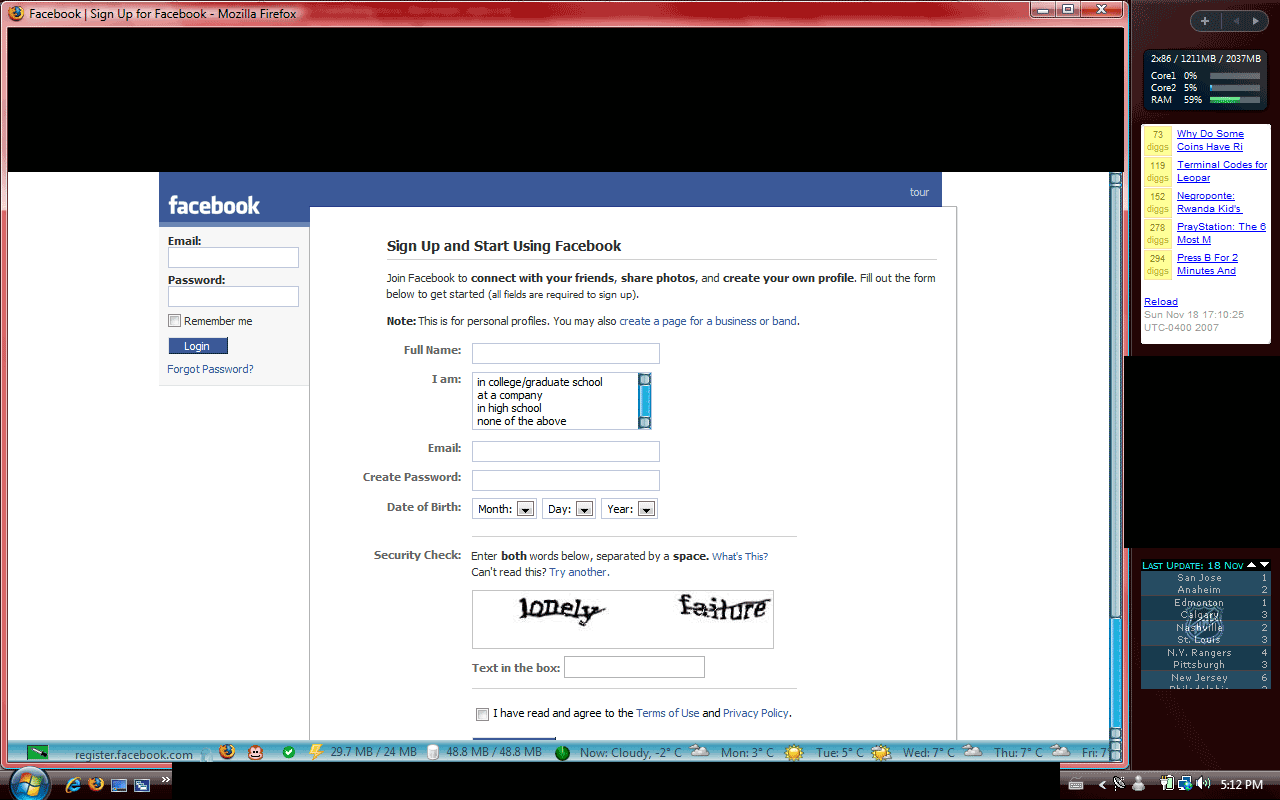
When you get this image on facebook then you know things are going REALLY bad!!

You know that things are NOT GOING YOUR WAY when you get this image while trying to sign up for your Facebook account!

You'll have to click on the image to enlarge it... See what the security check words say... Hilarious...


FACEBOOK IS NOT THE ANSWER PEOPLE!!! Reach out and touch someone today.

Technorati tags: , , ,

Monday
Nov192007

Finding the strength to do what I like least... Advice for people pleasers.

So, are there any other 'people pleasers' out there? You know the kind - you say yes to things you really should say no to...

This morning as I got out of bed at 5am because I knew that the 80km drive from Pretoria to Turffontein in Johannesburg was going to be difficult on a Monday morning - it took over two hours , and that was actually quite a pleasant surprise.

And, while I was in the traffic I was thinking "here I am battling the traffic so that I can spend a day moderating hundreds of exam scripts"... I am not a fan of marking. I like people, not paper. Put me in front of a group of students, but don't put me in a room with their exams! AAAAAaaaaarrrrggghhhh.... It was not a pleasant thought, battling the traffic to go and do something that I don't really enjoy doing.

The great encouragement is that I only have to do this for two days. I know many people who do this 5 days a week for 48 weeks of the year (not marking [that's grading for the Americans]... I actually know some people who LIKE marking!) No, I mean there are people who battle the traffic each and every day to go to jobs that rob them of life...

I thought about you, and it struck me again, life is not meant to be that way! But, let's be honest, there are very few people that have the privilege to choose from a variety of different job options. Most of us do what we do because we need to pay the rent, put kids through school, pay our cars, and put food on the table.

So, I walked into a room FULL of scripts, they were PILED HIGH... My heart sank. I said a little prayer, something like "Lord, help a brother here... I have two days of this. Why did I agree to help with this?"

Then these verses came to mind:

Whatever you do, work at it with all your heart, as working for the Lord, not for men, since you know that you will receive an inheritance from the Lord as a reward. It is the Lord Christ you are serving. [Col 3:23-24].

I remember reading in Bob Buford's great book, 'Half time', that if we want to bring blessing to God, and find blessing for ourselves, we don't necessarily need to do things that please us (that's what a 'brat' does - in ethics we call is hedonism, the pursuit of pleasure). Not everything that is worthwhile is pleasurable (although that is generally an easy way to find momentary happiness).

BUT, constant pleasure is NOT the reality of daily life. There must be something deeper, something more significant, something more real that makes life, and the tasks of life, more meaningful.

Dietrich Bonhoeffer said that what made life wortwhile was learning to live for others. So, as I picked up each of the scripts to look through it. As I picked up each markers report to read it. As I placed my pen on the paper to write, I thought about the people, and the God of those people...

I said a little prayer to our God and remembered that these people are still working towards their FIRST degree, while I have the joy of having completed a few. Many of them cannot afford to pay their fees, they work a job and come home to study at night after a hard day, they do it because of the God that we love, and the people that our God loves... So, I said to "Dion, you're not doing this because you enjoy it. You're doing it because you can do it, others need it done, and you're God's servant in this place. So, do it for God, and these people who God loves."

And so, the day passed, and it was not a frustrating day of grading papers, counting marks, and considering 'assessment tools', rather it was a day of serving God and God's people.

I don't know if it will work for you. I sure hope that there is something that you can glean from this experience that will make your work an act of service, a moment of praise; something you can do for God and those whom God loves.

If you need a prayer please feel free to drop me a line. I'll be glad to offer a prayer for you. I ask you to do the same for me.

Tomorrow I'll awake and make my way back through the traffic in service of our God and God's people.

Technorati tags: , , , ,

Sunday
Nov182007

Wohoo! Hitting the big time - my little prayer book is listed on MobiPocket!

The internet is truly amazing! I signed up my little prayer book on Amazon.com, and it has been selling like hotcakes (not exactly retirement money, since I listed it without considering what it would cost me to post it to the Amazon warehouse in the USA... So, I make a loss of a few Rand on each paper copy that sells).

However, it is just been listed on Mobipocket and it is selling wonderfully well there too! The fantastic thing about Mobipocket is that once I have uploaded the completed file I don't need to do a thing! I simply check my account from time to time to see how many copies have been sold and then start worrying about declaring the income (so far only a few hundred Rand, but still!) to the Taxman... Also, remember, that all profits go to the Zimbabwe relief!

I will add my other two books as soon as the paper copies are available and I have posted out the pre-orders to those of you who have ordered copies.

Here's a picture of my little book on Mobipocket.com.

By the way, Mobipocket is a great way to read books (other than mine), I have bought quite a few books to read on my Nokia, Palm, and PocketPC phones (I even have the client for my Sony Vaio Windows XP PC). In the past I have bought Brian Mclaren's book 'A generous orthodoxy', a few Michael Moore books, and even Alexander Mcall Smith.

Simply download the client and then download a few 'trial' copies of ebooks from the site. Test it for yourself to see if it works.

Blessings, and thanks for sharing in my excitement! I'm off to preach at Bryanston Methodist Church.

Technorati tags: , , ,

Sunday
Nov182007

94.7 cycle tour! Blessings, excuses and commitments!

Today there will be about 40 000 cyclists on the streets of Johannesburg. They are all taking part in the premier cycling tour of Gauteng, the Pick n' Pay 94.7.

I have never ridden this one myself. Although, I have done 9 Cape Argus cycle tours. Riding in a race like this is a truly magnificent experience. Although I confess it is never a race for me, rather it is like 'facebook on wheels' - a chance to chat, check out the scenery and build some lasting memories.

Well, blessings to all those who are riding already! I know Steve Mulder is doing the race (Alison, his sister, joined us for some tea for Liam's birthday), Wayne Taylor the minister of Westview Methodist Church in Centurion is also riding (I know that because I am about to leave to conduct his two morning services while he stretches a few muscles), and my cousin John - who is a beast of a man (he fears no road, no hill, and no challenge! In fact when hills go to sleep at night they put their beds on bricks for fear of him!)

I wish I was there with you guys!

Why am I not doing it? Well, in the 4 years that we have lived in Gauteng I have told myself that I am too busy to train for a ride like this... It's a sorry excuse, I know! I would love to do one more Argus to get a yellow number, and also do the 94.7 next year!

So, here's a commitment - I am going to get back on my bike (that would be the bicycle, not the Vespa or 'the beast') from Monday, and next year I hope to ride the 94.7. Anyone willing to join me?

OK, off to Church I go - have a blessed day!

PS. If you've ridden the race today (or any other time) drop me a line to let me know how it went for you!

Technorati tags: , ,

Saturday
Nov172007

Some steps to follow if you're wanting to do a research Masters or Doctoral degree in South Africa.

There are many reasons why people wish to do senior degrees in South Africa. Foremost among them are that we have one of the highest standards of Graduate education in the world, whilst our prices for registration are among the lowest in the world.

We follow the European / British system in most Southern African Universities. That means that most South African students would have at least two degrees before registering for a Masters degree (a Bachelors degree within their field - unlike the US Bachelors degrees, South Africa degrees, like those at Oxford and Cambridge, are already with a field (e.g, Bachelor of Theology, or Bachelor of Commerce, or Bachelor of Arts, or Bachelor of Science). After completing a Bachelors degree (normally 3 or 4 years) one will go on to do your first degree that involves some measure of independent research - an Honours degree within your field (again this is different from a Degree with Honours received in the US. An honours degree is an independent degree, normally taking a year to complete, and it allows direct access to a research Masters degree. Once again, this degree is subject based).

So, if you wish to study at a South African University and do a Masters degree you will need at least a 4 year undergraduate degree, or a Bachelors degree and an Honours degree.

So, you've arrived at the point where you are ready to start independent research (writing a Thesis, or Dissertation, as the case may be). Here are a few suggestions for persons wishing to start this process (these thoughts stem from a few emails that I have written for students over the last few years, but particularly from a note I wrote for a friend who is considering doing a Masters Degree in Theology):

1. A common question: Can I work out my research area and write my research proposal before registering officially at a University? In theory this is possible - one can start reading, researching and working towards your Masters degree before you register. However, in reality it is essential to work with a chosen supervisor. The reason he or she works with you is to help you learn the skill, and gather necessary content, for your work (much of which you will need guidance in since you are only setting out in self directed research at that level).

I am yet to hear of a student who works out their topic, finds a supervisor, and does not have to spend 6 months to a year reading additional work, reworking their proposal, and then only starting to write. My suggestion would be that you try to find someone to work alongside (e.g., a friend of someone whom you know who already has a doctorate, and preferably someone who has experience of supervising Masters and Doctoral students) who can at least point you in the right direction, help you to formulate your thoughts and narrow your research topic. But, if you choose to start your work on your own it is likely that when you register there will be some need for change, flexibility and negotiation, on both your research topic and your content. A Masters or Doctoral is always a joint effort between the student and their subject matter expert. HOWEVER, you must at least have some idea of what you want to study (e.g., Which books of the Bible are most commonly used in student sermons in the Methodist church of Southern Africa and what this tells us about the theology of Methodist Student ministers). Once you have that broad area it is best to contact a supervisor and start working out the nuts and bolts...

2. A very good book to help you succeed in your Masters and Doctoral studies: There is a wonderful book out there that I suggest to all M and D students I supervise and work with. It is called: “How to succeed in your Master’s and Doctoral Studies”. Mouton, J. Van Schaik Publishers. Cape Town, 2000. ISBN062702484. This is an invaluable resource! You should be able to get a copy at most University libraries, I have even heard of it being in some public libraries - however, I would suggest that if you can afford to, buy yourself a copy. An M is sure to lead to a D! In that case you will use it again.

3. How decide on a research topic or area? With regard to your research area it is essential that you try to do a few things. First, make sure you have a topic that is achievable. Second, make sure that there is enough information out there to conduct your research. Third, be sure that no one else has already done the research you wish to do.

This is the reason why one does a research proposal. There are basically 3 steps to preparing for your research proposal (which will need to be approved both by your Supervisor and the Higher Degrees Committee):

  • Work out exactly what you wish to research (it has to be achievable, narrow enough to be covered, and capable of being written up within the scope of your project and the time limits set for your degree (most Masters degrees have a maximum limit of 3 years and PhD's 5 y ears). Your topic must also be something that is scholarly and not yet done by other scholars. A common mistake among students when they start out is making their topic too large or wide! The image that I use to explain the difference between this level of research, and what one does in your undergraduate degree, is that your research should not be like an open cast mine (shallow and wide), rather it should be like a shaft mine (deep and narrow). The reason for this is that in order to award a Masters degree one must prove that one has MASTERED all of the literature, issues, discussions, and research, in that area. So if your topic is too wide you will never be able to read all the books, interview all the people, understand all the issues, trace the arguments, and then present them in a scholarly report. For example, students often suggest a topic like "The use of Wesley's hymns in the Church" doing research on ALL churches in the world, and ALL of Wesley's hymns is just impossible! So, you either need to narrow your demographic (i.e., their use among black clergy in rural areas), or set a clear boundaries for your research (e.g., most often by introducing things such as dates (between 1980 and 1985), geography (within Methodist Churches in the Johannesburg east circuit), or population groups (women's organisations in urban Methodist churches in Gauteng). Doing this makes the research and the reporting on the research possible).

  • Once you have your clearly defined research area, and research question, you need to make sure no-one else has done already covered that research topic (search the internet, go to a University Library, ask the Subject librarian, e.g., in Theology, to search the ATLA databases for words around your topic, get as many of the articles, chapters, and books on this subject and make sure it is worthwhile researching, try to find others who may have done similar research and speak with them). This will also help you to start compiling your reading list and bibliography for your research proposal. You will need to supply at least a basic understanding of the seminal arguments, scholars, and texts in that area. Moreover it will also help you to clearly formulate what you aim to cover and how you'll do it (i.e., will you interview persons, will you send out questionnaires, where will you get your statistics from, how will you interpret them? Then how will you relate what you find to the area of your research. For example if your study is in Theology, how will you relate what you've discovered to Christian doctrine, or Church practice, or passages from scripture, or what has happened in Church history).

  • Once you have all this data (a suggested topic, a defined research area, an idea of the literature and issues in that area, a proposal of how you will conduct your research, who will supervise your work) then you write up your research proposal according the guidelines of the University at which you intend to register (each University has slightly different requirements).

If I can offer you some advice to persons wishing to do senior degrees in South Africa, I would suggest that you include an African element in your research. I suggest this for a few reasons:

  • It is less likely that a topic with an African slant would have been covered by someone else (e.g., Prophecy in Methodist Churches in the XXXX Circuit).
  • It is important that we ask questions that are relevant to our context (this is both a responsibility to scholarship and a responsibility of our faith). Since the African voice has not yet gained extensive prominence in world scholarship we have a responsibility to make discoveries about our context and the richness that it can offer to all of humanity. I firmly believe that the African voice needs to be heard, we must contribute towards the international debate on important issues. Moreover, as a Christian if you are going to spend a great deal of time and energy doing creative and novel research, do it as an act of stewardship and service (not just to gain a degree). So, add something of value that has not yet been done. Moreover, when you do that you will find that your Thesis can quite easily be turned into a book (these things all open doors for ministry and further scholarship), or at least be published in some journal articles.

So, these are a few suggestions - I hope they offer some help and encouragement to persons wishing to engage in research degrees here in South Africa. There are few things quite as rewarding as contributing to scholarship and knowledge in areas that have not yet been charted.

Please feel free to contact me if you have any suggestions or queries.

Technorati tags: , ,

Saturday
Nov172007

Weird religion and the Academy - Flying Spaghetti Monster to star at American Academy of Religion.

The American Academy of religion is the most prestigious academic gathering for theologians across the globe. Today boingboing.net reposted that the Flying Spaghetti Monster will be making an appearance!

If you don't know who the Flying Spaghetti monster is, you're not up to date on mythology and religious eccentricity on the internet...

Here's the story (this is one conference I would love to attend - this is where culture, faith, and technology colide):


The Flying Spaghetti Monster will be discussed at the American Academy of Religion's annual meeting
200711161051 The title: "Evolutionary Controversy and a Side of Pasta: The Flying Spaghetti Monster and the Subversive Function of Religious Parody."
"For a lot of people they're just sort of fun responses to religion, or fun responses to organized religion. But I think it raises real questions about how people approach religion in their lives," said Samuel Snyder, one of the three Florida graduate students who will give talks at the meeting next Monday along with Alyssa Beall of Syracuse University.

The presenters' titles seem almost a parody themselves of academic jargon. Snyder will speak about "Holy Pasta and Authentic Sauce: The Flying Spaghetti Monster's Messy Implications for Theorizing Religion," while Gavin Van Horn's presentation is titled "Noodling around with Religion: Carnival Play, Monstrous Humor, and the Noodly Master."

Using a framework developed by literary critic Mikhail Bakhtin, Van Horn promises in his abstract to explore how, "in a carnivalesque fashion, the Flying Spaghetti Monster elevates the low (the bodily, the material, the inorganic) to bring down the high (the sacred, the religiously dogmatic, the culturally authoritative)."

Link (Thanks, Rick!)

Technorati tags: , , , ,

Saturday
Nov172007

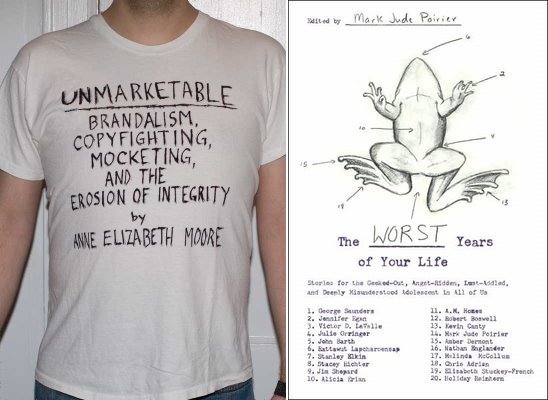
Pictures of the BEST book covers for 2007... I could do with a few tips for my two new books! [Pic]

The Book Design Review Blog has picked its top book covers for 2007 -- there are some superb covers here -- I'm especially fond of these two, for Unmarketable: Brandalism, Copyfighting, Mocketing, and the Erosion of Integrity, and The Worst Years of Your Life. Got favorites of your own? Link 'em in the comments. Link (via Kottke)
Repost from boingboing.net

Technorati tags: , , , ,

Saturday
Nov172007

Prayers filled with gossip, and Fox News Porn.

There is a certain kind of prayer (or prayer request) that makes me mad! It is the kind of prayer where a person actually doesn't want to pray for the other person, or persons, rather they simply want to gossip! Have you ever heard prayers of that nature? I sure have! "Oh Lord, please help sister Mary, she is drinking again today, and she hasn't pad the rent, but she could afford to buy those new shoes I saw her wearing when she was dodging work on Tuesday afternoon...."

These prayers are quite easy to spot, since their focuss is all wrong! The focus is not on care, concern, or God's help, but rather on the juicy details of someone else's life...

Well, Fox News has just been busted for something similar. Here's the story:

Fox News Porn is a collection of raunchy outtakes from the Fox "News" Network, where hypocritical prigs like Bill O'Reilly revel in prurience while condemning it. This condemnation is largely indistinguishable from a celebration -- as when Sean Hannity visits a brothel and asks snotty, explicit questions of the workers there while his camera lovingly pans across their bare flesh.

The site is the creation of filmmaker Robert Greenwald, whose documentary Outfoxed is a masterful takedown of the Murdoch empire. Fox News Porn created a brief but spectacular net-storm when an overzealous moderator for Digg took the site off the Digg front page and threatened to suspend Greenwald's account for violating Digg's Terms of Service. However, a day later, Digg management reversed the decision. In founder Kevin Rose's words, "Our fault. Digg on." Link (Thanks, Kevin and Pete!)

Technorati tags: , , , ,

Saturday
Nov172007

A slow day... will post later!

Yup, it's Liam the great's 1st birthday party today
plus I had to be up at 4am to make it for the elders
meeting at Bryanston at 6am, and then had a wedding
in Alexandra Township at 7.30am....

So, I'll post some thoughts a little later!

Thanks for looking in!

Blessings,

Dion

Friday
Nov162007

First there was 'carckberry' for the blackberry addicts - now the iPhone takes internet addiction to a NEW HIGH!! [Pic]

iPhone lurv....

Yep, that's what it is! I have personally (forgive me) lusted after one of these devices for some time now. They are available in SA, but only the 'black market' as 'cracked' devices... So, my desire my be kept in check for a few months more! For now, my Nokia E90 does the trick...

However, when I saw this cartoon from my friend Andre, I couldn't help but laugh! At first there were reports of people becoming addicted to their Blackberry cell phones - a condition known as 'crackberry', since many have found them to be as addictive a Crack! (I have personally felt the pain and withdrawal of being with constant email and internet access - it's not a pretty sight! But then again, neither is walking into a wall, or another person, when you're typing a 20 page reply using your thumbs while walking through the mall!)

Dilbert always seems to hit the SWEET SPOT!

Anyone out there willing to 'donate' an iPhone to a student of the mind to see how one combats this addiction? Contact me offsite... I'll gladly help you out!

Technorati tags: , , , ,

Friday
Nov162007

All praise and thanks to God! Our miracle son turns 1!


Liam and Courtney (still asleep) opening his Birthday presents.

Friends, please join us in praising and thanking God for the miracle and blessing of Liam's first birthday!

He is perfect and healthy in every way - we cannot begin to express how thankful we are for the miracle of his life! Please will you join us in thanking God for his health and development? He has come so far in the last year, from 1kg at birth to a healthy 10kg's. He still has some way to go, but there is nothing that love, care and a bit of occupational therapy can't sort out!

Here's the story of his birth and here are some moments from this first year of his life. And here are a few posts specifically about Liam the Great!

As you will know Megan and I fast and pray each Friday for children and premature babies, and their families of course, so it is wonderfully fitting that Liam's first birthday falls on Friday the 16th of November 2007. Today we will remember friends that we have made on this journey - some who have experienced the joy of a frail child growing strong, and those who have had to endure the sorrow and pain of loosing their precious little one.

Once again, we are so grateful to all our family and friends we have been so caring, patient, and supportive over the last year. It is a great blessing to be loved!

So, if you would like to leave little Liam a message please do so in the comments, or email it to me directly (as some have done already! Thank you!) We'll print and keep them for him to read in years to come.

A very happy dad!